Bedroom Storage Zones: Give Everything a Place
How to divide a bedroom into sleep, dressing, storage and landing zones, decide where things live by how often you use them, and spot a zone that is in the wrong place.
If your things drift around the room, the cause is rarely a lack of storage. More often nothing has a fixed home, or the home it has is in the wrong part of the room. The glasses live in a drawer across the room from the bed, so they end up on the floor beside it.
Bedroom storage zones fix this with one idea: things are stored where they are used. You divide the room into a few areas, give each area one job, and keep in it only what that job needs. Once the zones are right, putting things away takes a step or two.
What a zone is
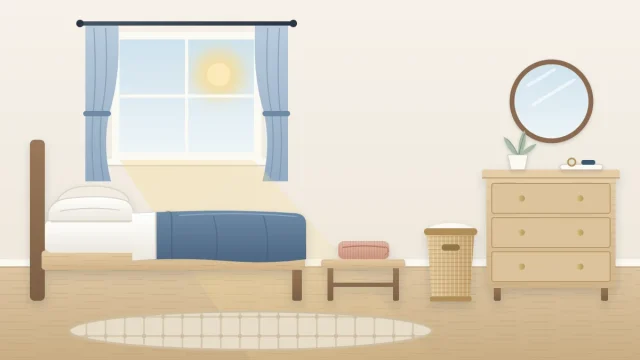
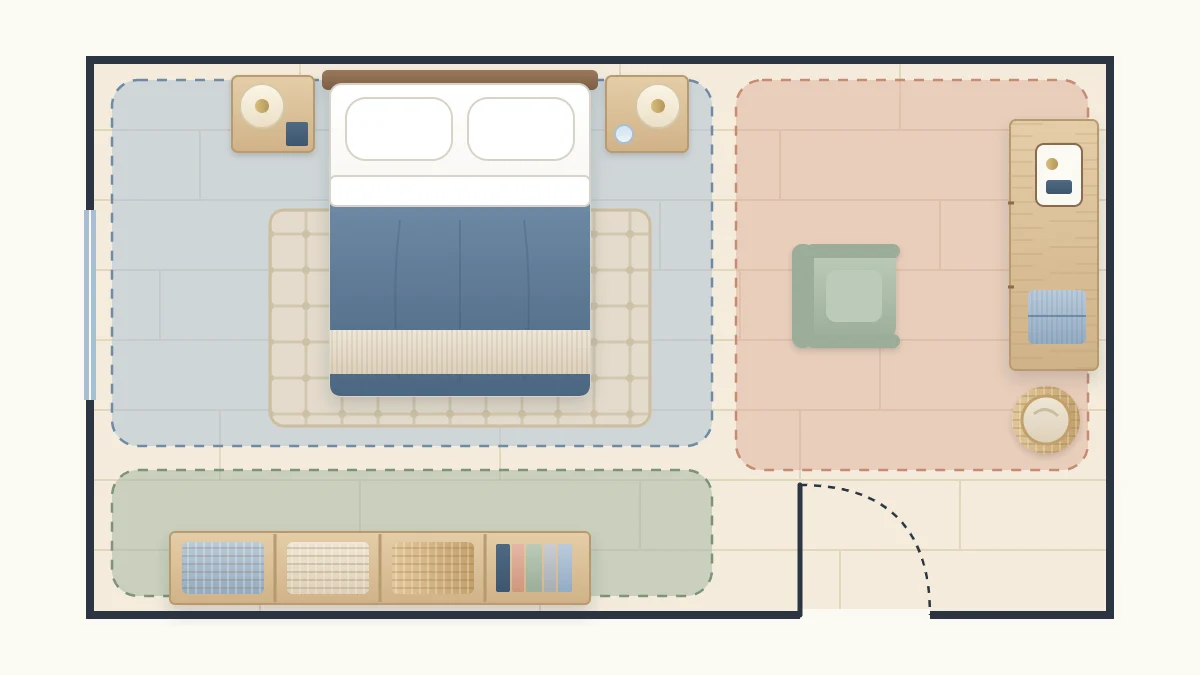
A zone is an area of the room with one job. It is not a piece of furniture, although furniture usually sits at its center. The sleep zone is the bed plus whatever is within reach of it. The dressing zone is the spot where you stand to get dressed plus the storage you can reach from there.
Zones need no dividers or markings. When you decide where something lives, you ask which zone uses it, and it goes there.
The usual zones and what lives in each
Most bedrooms have four zones, and some have a fifth. The table is a starting point to adapt, not a rule.
| Zone | What belongs | Typical furniture |
|---|---|---|
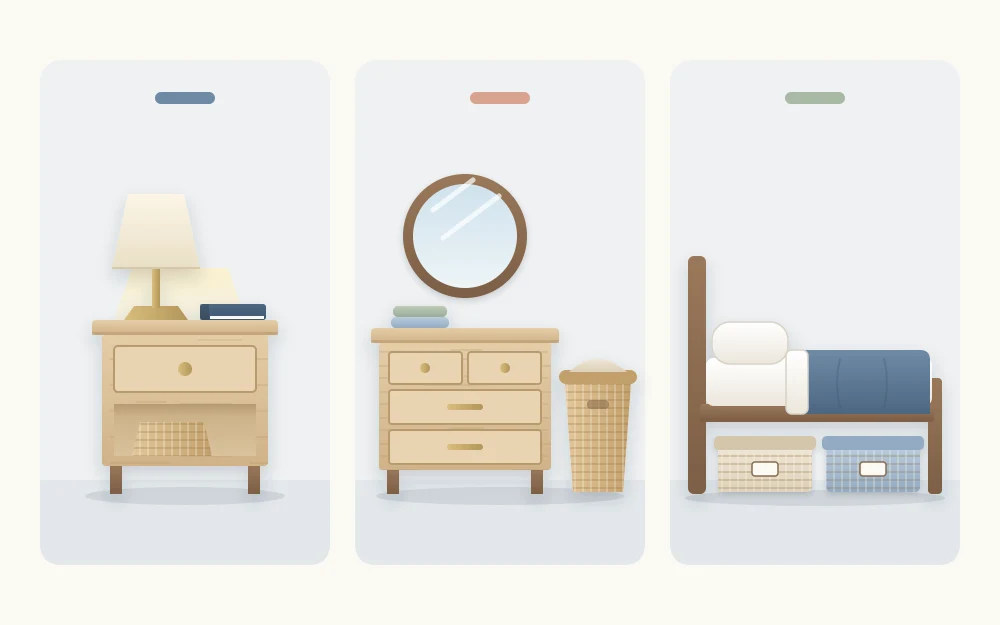
| Sleep | Only what you use in bed or on waking: lamp, book, glasses, water, alarm | Bed, nightstand |
| Dressing | Everyday clothes, tomorrow’s outfit, worn-once clothes, laundry | Dresser, mirror, hamper, a hook or valet stand |
| Storage | Things used rarely: out-of-season clothes, spare bedding, luggage | Under-bed boxes, high shelves |
| Landing spot | Daily carry items: keys, bag, watch, glasses, phone | A tray, a hook, a small shelf near the door |
| Optional | Work or reading items, if the room must hold them | Desk or reading chair |
The sleep zone
This is the bed and the bedside. The test for anything kept here is simple: do you use it from bed, or in the first minute after waking? If not, it belongs to another zone. Keeping the list short is most of the work, and the guide to what to keep on a nightstand goes through it item by item.
The dressing zone
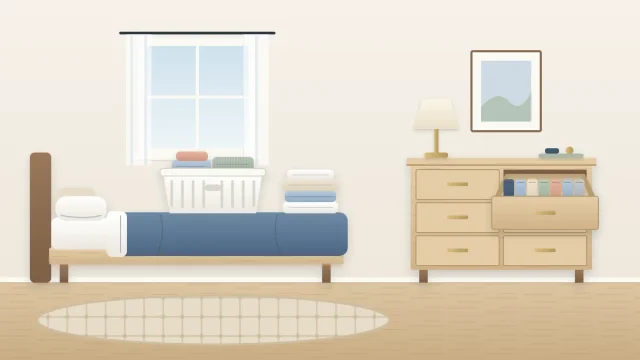
The dressing zone is where clothes come off and go on. It needs three things close together: clean clothes, a place for dirty ones, and a place for worn-once clothes that are not ready for the wash. When the hamper sits in a different part of the room from where you undress, clothes land on the floor in between.
The dresser is the anchor of this zone for most rooms, and how its drawers are assigned matters as much as where it stands. See the guide to arranging dresser drawers so they stay tidy.
The storage zone
Some things live in the bedroom but are used a few times a year. They should take the least convenient space so the convenient space stays free: the floor under the bed and the highest shelves. For the first, there are under-bed storage ideas covering containers and what suits them.
The landing spot
The landing spot is where daily carry items go when you walk in. It can be as small as a tray on the dresser top and a hook for a bag. Without one, keys and a watch land on whichever surface is nearest.
An optional zone
If the bedroom must also hold a desk or a reading chair, give that activity its own area with clear edges. Work papers stay at the desk, and the chair holds a person and a book, not the week’s clothes.
Decide by how often you use things
Within each zone, frequency of use decides the exact home. A simple scale works for most rooms:
- Daily: within arm’s reach of where you use it, with no lid to lift and nothing to move first.
- Weekly: a step or a bend away. Lower drawers, a shelf at eye level, a bin you slide out.
- Seasonal or rare: out of the way. Under the bed, the top shelf, the back of a deep drawer.
The mistake to look for is a rarely used item sitting in a daily spot, such as a top drawer full of old cables while the socks live somewhere less convenient.
Map your zones on a rough sketch
A sketch takes ten minutes and saves moving furniture twice. It does not need to be to scale.
- Draw the outline of the room with the door, windows, any closet door and the outlets you use.
- Add the furniture that cannot easily move, usually the bed.
- Mark where you actually stand to get dressed and where you set things down when you come in. Record what you do now, not what you plan to do.
- Circle each zone around those spots and write its job inside the circle.
- Check that each zone has storage inside its circle. If the dressing zone has no hamper in it, or the sleep zone has no surface, that is the gap to fill.
Zones can overlap in a small room: a dresser beside the bed can also serve as a nightstand. What matters is that each item still has one home.
Good to know
If your storage zone uses a tall shelf unit or wardrobe, anchor it to the wall following the furniture maker’s instructions, and put heavy things on the lowest shelves. High shelves suit light items only; there is more on this in the guide to organizing bedroom shelves.
How to tell a zone is in the wrong place
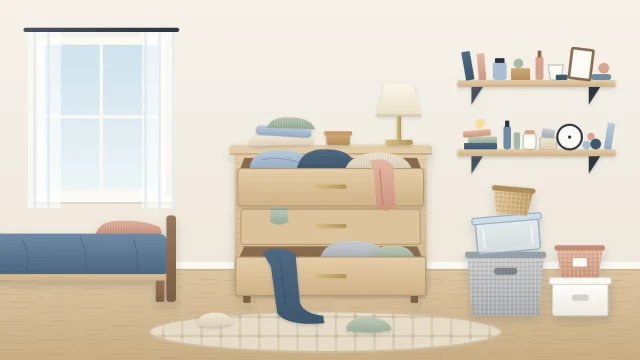
Piles are useful evidence. A pile forms where an activity really happens, whatever the plan says. Look at where things collect and ask what that spot is being used for.
- Clothes on a chair or the end of the bed: that is where you undress. Move the hamper there and add a hook or two for worn-once clothes.
- Keys, coins and receipts on the nightstand: the landing spot is missing or too far from the door.
- Books and cups on the floor by the bed: the sleep zone has too little surface, or the surface is full of things that belong elsewhere.
- Clean laundry sitting in its basket for days: the homes for those clothes are too full or awkward to reach.
In each case, moving the storage to the pile is easier than changing the habit.
Rooms change, so repeat this check every few months and adjust one zone at a time.
Frequently asked questions
How many zones should a bedroom have?
Most bedrooms work with four: a sleep zone around the bed, a dressing zone around the dresser and hamper, a storage zone for rarely used things, and a small landing spot for daily carry items. Add a fifth only if the room also has to hold a desk or a reading chair.
Can zones work in a very small bedroom?
Yes. In a small room the zones overlap and share furniture, for example a dresser that also acts as a nightstand. The idea stays the same: each item has one home, close to where you use it, and rarely used things take the least convenient space such as under the bed.
What if two people share the bedroom?
Keep the same zones, then split each one. Each person gets a side of the bed with a bedside surface, their own drawers in the dressing zone and their own landing spot, even if it is one half of a tray. Shared items such as spare bedding go in the storage zone.