A Short Daily Bedroom Reset Routine That Keeps Clutter Away
A short morning and evening routine of eight small tasks that returns everything in the bedroom to its home, with a checklist and what to change when a task keeps getting skipped.
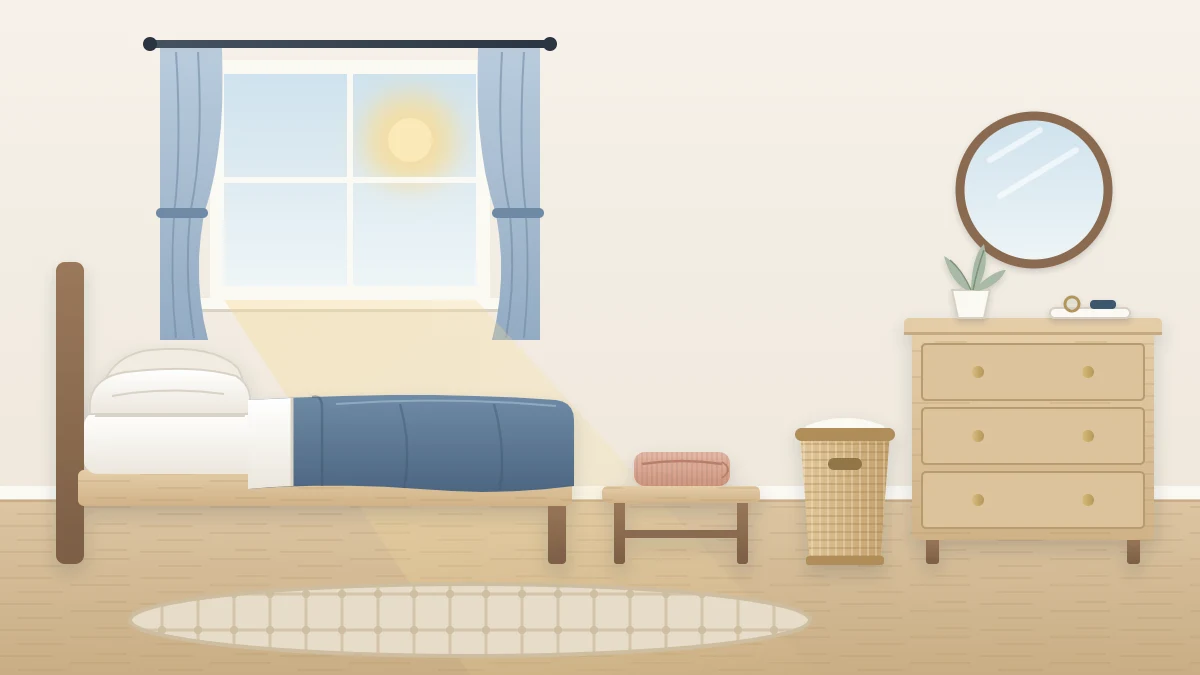
Getting a bedroom tidy is one job. Keeping it that way through an ordinary week, with early starts, late evenings and laundry in between, is a different one. What closes the gap is rarely a bigger weekend clean. It is a daily bedroom reset: a few small tasks, done at the same two points each day, that return the room to its starting position.
The routine below has a morning part and an evening part. Each is short on purpose, a few minutes for most rooms, because a routine you can finish when you are tired is the only kind that lasts.
What a reset is, and what it is not
A reset is not cleaning and it is not organizing. Nothing gets sorted, decided or rearranged. Every task is a return: an item goes back to a home that already exists. That is why it can be quick, and why it does not ask for any thought at the end of a long day.
It also means the reset is only as good as the homes behind it. If clothes have nowhere to go, no routine will keep them off the chair. More on that further down.
The morning part
Four tasks, done before you leave the room:
- Pull the bed covers up. A simple version counts: duvet or comforter pulled straight, pillows at the head. The bed is the largest surface in the room, and when it is flat it stops collecting things.
- Open the curtains or blinds. Daylight shows what else is out of place.
- Take cups and dishes out with you. You are walking to the kitchen anyway. One trip now saves a collection later.
- Put nightwear in its place. Under the pillow, on a hook, in a drawer or in the hamper. Any of these works as long as it is the same place every day.
The evening part
The evening is where most of the drift is caught. Do it before you get into bed, or earlier if you tend to run out of steam.
- Send the day’s clothes to one of three places. Clean items go back into storage. Worn-once clothes go to their spot, such as a hook or a valet stand. Everything else goes in the hamper. There is no fourth place.
- Clear the chair and the floor. Whatever has landed there during the day goes home now, while it is still a handful and not a heap.
- Return the day’s items to the landing spot. Keys, wallet, watch, glasses and the contents of your pockets go to the tray or dish where you will look for them tomorrow.
- Reset the nightstand. Keep what you need tonight and remove the rest: yesterday’s glass, wrappers, the things that drifted over. The guide to nightstand organization covers what earns a place there.

The routine as a checklist
| When | Task |
|---|---|
| Morning | Pull the bed covers up |
| Morning | Open the curtains or blinds |
| Morning | Carry cups and dishes out |
| Morning | Put nightwear in its place |
| Evening | Clothes to storage, the worn-once spot or the hamper |
| Evening | Clear the chair and the floor |
| Evening | Day’s items to the landing spot |
| Evening | Reset the nightstand |
Treat the list as a starting point. If you never bring cups into the bedroom, drop that line. If a desk lives in the room, add “clear the desk surface” to the evening. Keep the total short.
Why it works only with homes in place
Look back at the list and every line ends in a place: the hamper, the hook, the tray, the drawer. The routine holds because none of those places has to be invented on the spot. Where a home is missing, the task turns into a decision, and decisions are what get postponed at eleven at night.
So before you start, check that each of these exists in your room:
- a hamper that is within a step or two of where you undress
- a named spot for worn-once clothes, with a limit on how much it holds
- a landing spot for daily carry items
- drawers and shelves loose enough that putting something back takes one hand
If you add hooks for worn-once clothes, mount them according to the product instructions and within the limits it states, and check your lease first if you rent.
When a task keeps getting skipped
A skipped task is information, not a failure. When the same one is missed several days running, the usual cause is that the home is in the wrong place or is awkward to use.
- Clothes still land on the chair. The hamper may be too far away, have a lid that needs two hands, or be full. Move it, change it or empty it more often.
- Pocket items end up on the dresser. The landing spot is not where you actually empty your pockets. Move the tray to that surface.
- The bed stays unmade. There may be too many layers. Fewer pieces make a faster job.
The same spots give trouble in most rooms. They are mapped out, with a fix for each, in the guide to bedroom clutter hotspots.
Tip
Change the room before you blame the habit. Moving a hamper three steps often does more than any amount of resolve.
How to make it stick
Tie it to something you already do. The morning part can follow getting dressed; the evening part can follow brushing your teeth or plugging in your phone. An existing habit is a more reliable cue than a reminder.
Keep it short enough for a bad day. If the whole list feels like too much, do the smallest version: covers up in the morning, clothes to their three places at night. A two-task reset done daily beats a full one done twice a week.
Share it out in a shared room. Agree who does what, or simply that each person resets their own side, their own clothes and their own nightstand. Shared surfaces such as the dresser top need one owner or a clear split, or each person will assume the other is handling it.
Where the reset fits in the bigger picture
The daily reset handles what moved today. It does not deal with drawers that slowly overfill or categories that outgrow their space; those need a weekly and a seasonal look. How the three layers work together is set out in the guide on how to keep a bedroom organized.
Frequently asked questions
How long should a daily bedroom reset take?
For most rooms each part takes only a few minutes, but there is no set figure. If yours regularly takes much longer, it is usually a sign that some items have no home or that drawers are too full, and the room needs a round of organizing before a routine can hold.
Is it better to reset the bedroom in the morning or the evening?
Both, in small parts. The morning handles the bed, the curtains, dishes and nightwear. The evening handles clothes, the chair, the floor and the nightstand. If you can only manage one, choose the evening, since that is when most of the day's items are out of place.
What if I share the bedroom with someone who does not do the reset?
Start with what is yours: your side of the bed, your clothes, your nightstand. Then agree on one owner for each shared surface, such as the dresser top. A clear split works better than a general request to tidy, because each person knows exactly which few tasks are theirs.