Bedroom Shelf Organization: How to Arrange Open Shelves
Five steps for turning crowded open shelves into usable storage: empty, sort, group, assign shelves by reach, contain small things and leave space, plus how to choose containers that fit.
At a glance
What you need
- Tape measure
- Damp cloth
- Bins, boxes or baskets sized to the shelves
- A bag or box for items that belong elsewhere
- Blank label holders (optional)
Open shelves in a bedroom fill up quietly. A book goes on, then a charger, a pair of sunglasses, a hand cream, and within a few months the bookcase or the wall shelves are a display of everything that had nowhere else to go. Bedroom shelf organization is mostly a matter of reversing that: deciding what each shelf is for, and making loose things into units you can lift.
The steps below work for a freestanding shelf unit and for shelves fixed to the wall. This is a guide to where things are kept and how they are put away, not to how shelves are styled.
Start with safety: anchoring and load
Before putting anything back, check how the shelves are secured. A freestanding bookcase or shelf unit can tip forward, so it should be anchored to the wall following the furniture maker’s instructions, with fixings suited to your wall type. The U.S. Consumer Product Safety Commission’s Anchor It campaign explains tip-overs and anchoring in more detail.
Wall shelves are different: they hold only what their stated rating and their fixings allow. If you do not know the rating, treat the shelf as one for light things. On any kind of shelving, heavy items go low.
Good to know
If you rent, check the lease before drilling to anchor a unit or put up a shelf, and ask the landlord if it is unclear. Follow the product instructions for any fixing you use.
Step 1: Empty, wipe and sort
Take everything off, one shelf at a time if space is tight, and set it on the bed. Wipe each shelf with a damp cloth and let it dry. Starting from empty matters, because it is the only way to see how much space you really have.
Then sort what came off into three quick piles:
- Stays on the shelves. Things you use in the bedroom and that suit open storage.
- Belongs elsewhere. Items from other rooms, and bedroom items that have a better home in a drawer or on the nightstand.
- Leaves the house. Things to donate, recycle or throw away.
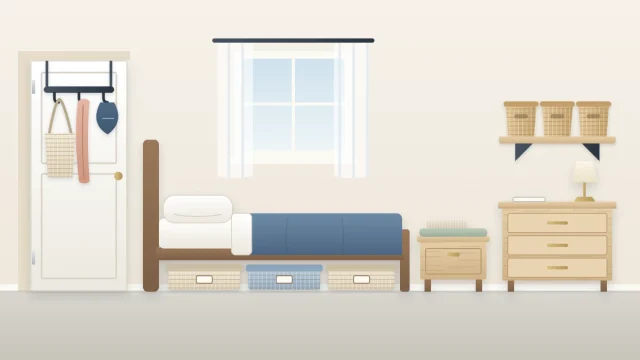
Carry the second pile to where it belongs before going on. If the shelves were the default spot for things with no home at all, the wider guide to bedroom storage ideas can help you find one for each.
Step 2: Group what stays
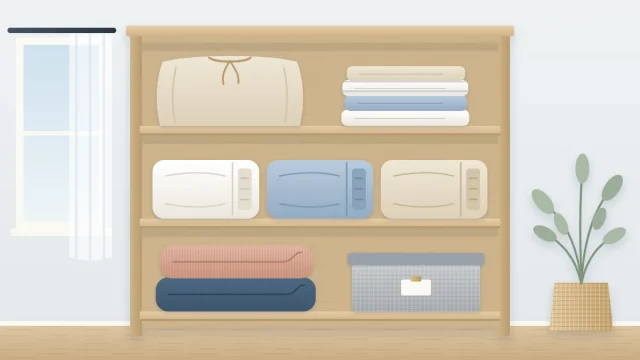
Put like with like: books, folded sweaters or jeans, bags, accessories, grooming items, keepsakes, paperwork that has to live here. Aim for a small number of broad categories. A category made of a single item usually belongs inside a neighboring one.
Step 3: Assign shelves by reach
Now give each category a shelf, working from how often you use it and how heavy it is.
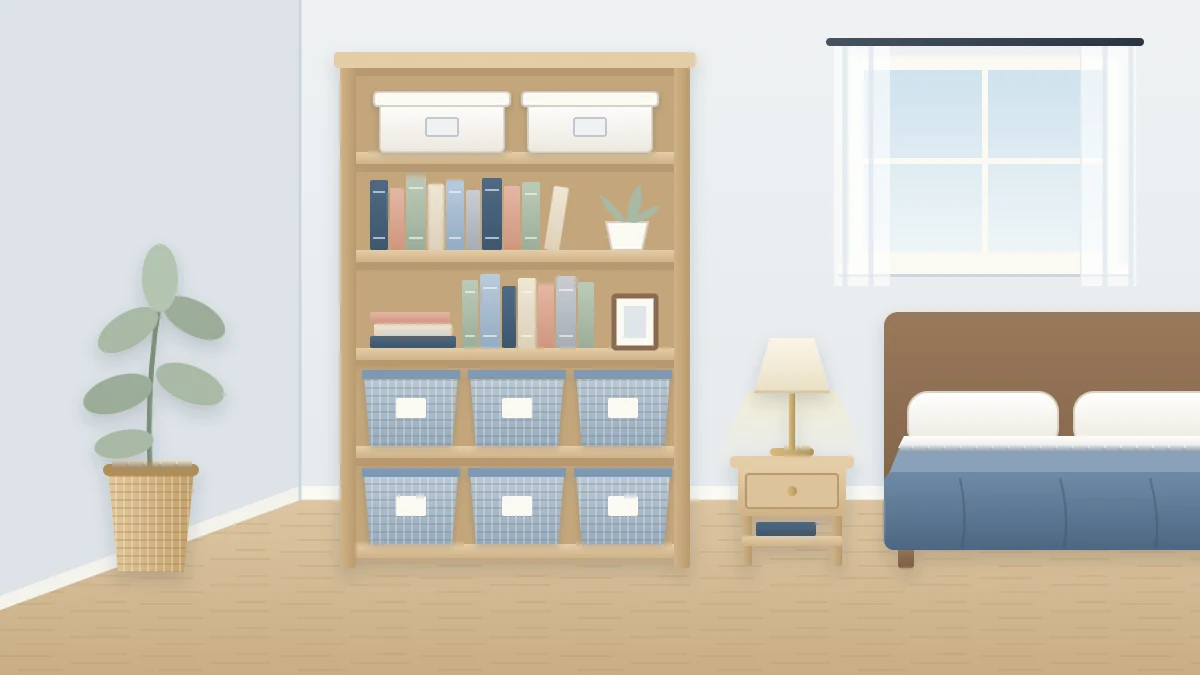
- Eye to waist height: what you use often. This is the easiest band to reach and to see into.
- Low shelves: heavy things, such as large books, boxes of paperwork or anything dense.
- High shelves: light things you rarely need, such as an empty bag or a box of keepsakes.
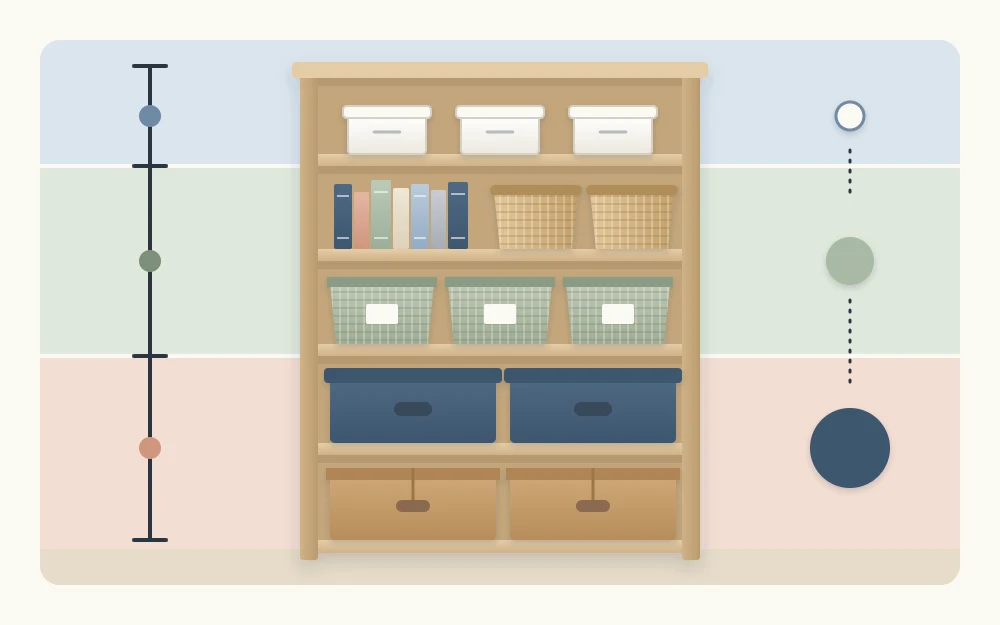
If you are adding shelves higher up the wall to gain room, the guide to vertical storage in a small bedroom looks at what is worth putting up there.
Step 4: Contain the small loose things
This is the step that changes how the shelves behave. Small items spread along an open shelf have no edges, so the group grows without anyone noticing. Put each category of small things into a bin, box or basket, and it becomes one object: one thing to lift down, one thing to wipe under, and a clear limit on how much the category can hold.
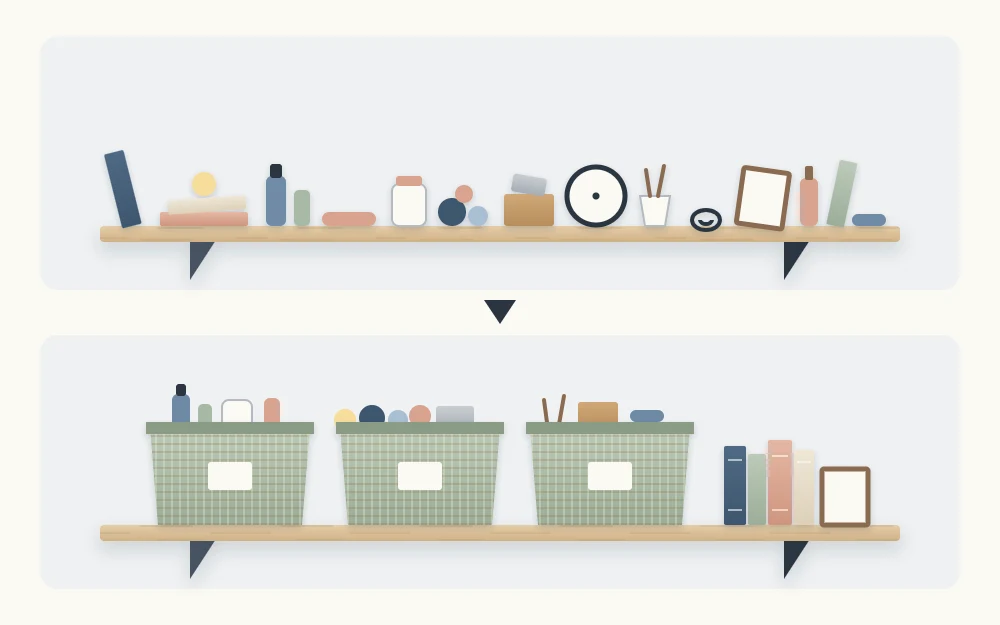
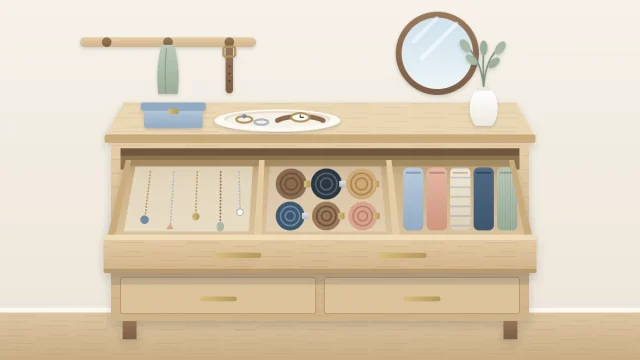
Jewelry, watches, belts and similar pieces need finer sorting than a bin gives; see the guide to organizing bedroom accessories for those.
Step 5: Place books, then leave space
Stand books upright with the spines out so each one can be pulled without moving the others. Where a row does not fill the shelf, a short flat stack of two or three larger books at the end works as a bookend. Avoid a second row behind the first; books at the back are effectively in storage.
Then stop before the shelf is full. Leave part of each shelf empty, perhaps a quarter as a starting point. The gap is what lets you slide a bin out, put a new book in, and set something down for a moment without starting a pile.
How to choose containers
Measure first. Take three measurements for each shelf: the depth from front to back, the clear width, and the height between this shelf and the one above. A bin should sit fully on the shelf without overhanging, and leave enough room above it for your hand. Shelves around 10 to 12 in (25 to 30 cm) deep are common, but measure your own before buying anything.
Use the same type across a shelf. Three matching bins in a row are calmer to look at than three different ones, and they use the width without odd gaps. Boxes and baskets you already own are fine if they are close in size.
Pick the material for the contents. Fabric bins are light and suit soft things. Rigid boxes stack and suit paperwork. Open baskets are quickest for items you grab daily; lidded boxes keep dust off things you rarely touch.
Make contents easy to find. In a shared room, a blank label holder on each bin that you fill in yourself, or simply keeping each category in the same position every time, helps everyone put things back in the right place.
Tip
Weigh a filled bin in your hands before it goes on a high shelf. If lifting it down above shoulder height feels awkward, it belongs lower.
Keeping the shelves that way
Open shelves show drift early, which is useful. When something appears on a shelf that has no category, either it has a home elsewhere or it needs one. When a bin overflows, the category has outgrown its space and it is time to thin it out. A quick look once a week, and a wipe when you dust the room, is usually enough to keep the arrangement in place.
Frequently asked questions
What should I keep on open bedroom shelves?
Things you use in the bedroom that are either large enough to stand on their own, such as books and folded sweaters, or small enough to be grouped in a bin. Very small or valuable items, and anything you would prefer not to dust, are usually better in a drawer.
Do I need to anchor a bookcase in the bedroom?
A freestanding bookcase or shelf unit should be anchored to the wall following the furniture maker's instructions, using fixings suited to your wall type. Keep heavy items on the lowest shelves as well. If you rent, check your lease or ask the landlord before drilling.
How do I stop shelves from turning into a dumping ground again?
Give every shelf a job and every small category a container, and leave part of each shelf empty. When an item shows up that fits no category, move it to its real home the same week. A full bin is a signal to thin that category out, not to add another bin.