Common Bedroom Organization Mistakes and How to Fix Them
Ten common reasons a tidy bedroom falls apart again, from buying bins too early to skipping the evening reset, each with a plain fix you can try this week.
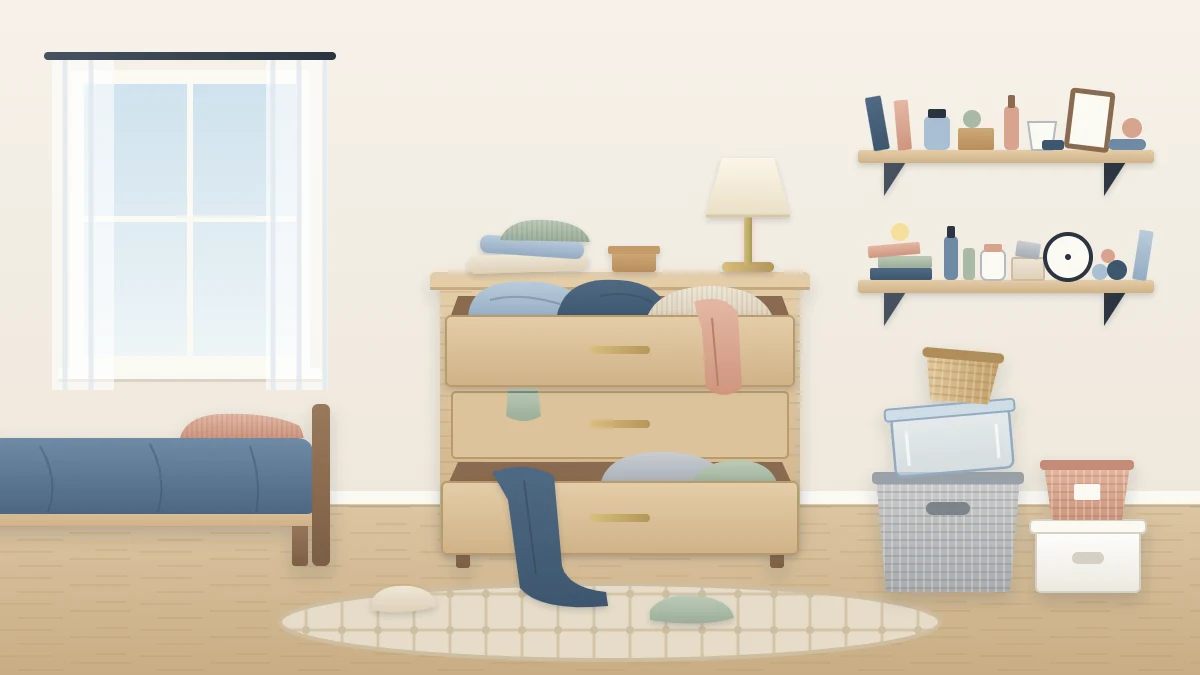
You tidy the bedroom on a Saturday, and by the following Thursday the chair is full again and the top of the dresser has disappeared. That pattern usually has little to do with effort. It comes from a handful of bedroom organization mistakes that almost everyone makes, because each of them looks like the sensible thing to do at the time.
Below are ten of the most frequent ones, grouped by where they show up. Each comes with the reason it backfires and a fix you can try this week.
Mistakes made before you start
1. Buying containers before decluttering
New bins feel like progress, but until you know what is staying you cannot know what size, shape or number of containers you need. The usual result is a stack of boxes that fit nothing.
The fix: sort first, then measure the drawer, shelf or floor space, and only then buy or reuse a container for a category that already exists. The order of work is laid out in the step-by-step guide to organizing a bedroom from start to finish.
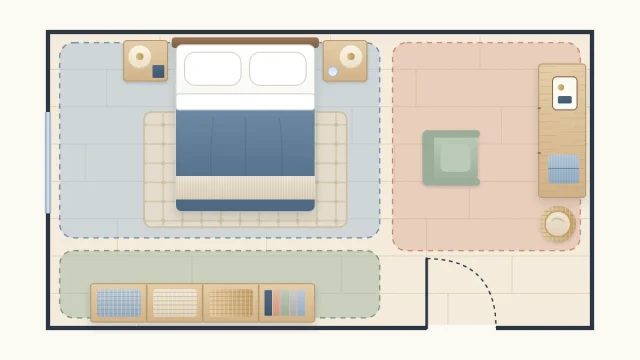
2. Organizing without zones
If the room has no areas with one clear job, each item is put wherever there happens to be a gap. Nothing has a logical home, so nothing gets returned to one.
The fix: decide what happens where (sleeping, dressing, getting ready, a landing spot for what you carry each day) and keep each group of things beside the place it is used. The guide to setting up bedroom storage zones walks through it.
Mistakes inside drawers and bins
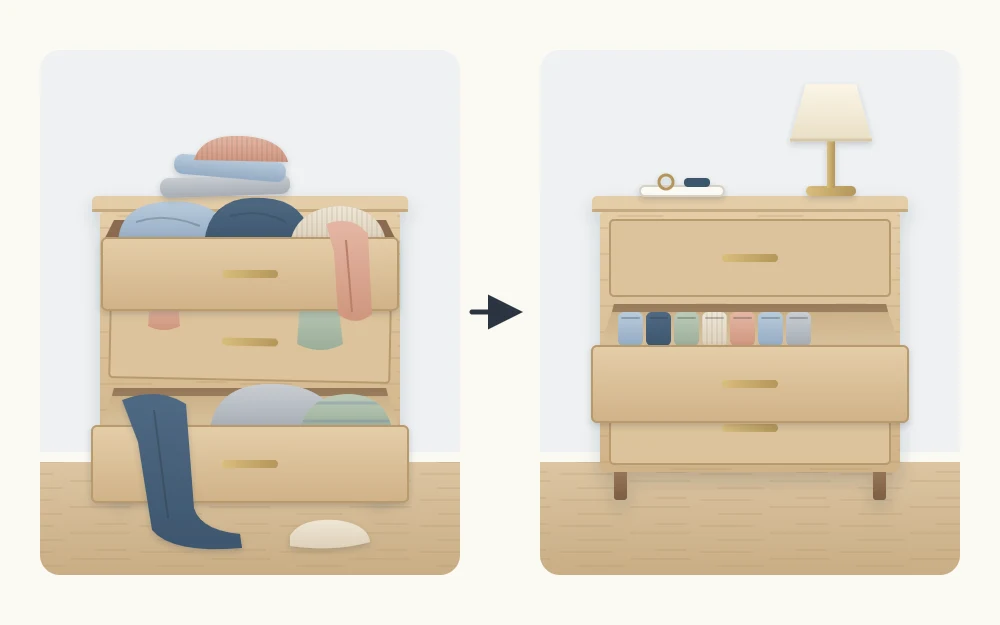
3. Overfilling
A drawer packed to the top technically holds everything. It also has to be pressed down with one hand and shoved shut with the other, which makes dropping a T-shirt on the chair the easier option.
The fix: aim to leave some of every drawer and bin empty, roughly a hand’s width as a starting point. If the category does not fit with that margin, the category is too large for the space.
4. Choosing a system that needs perfect folding
Some arrangements only work when every item is folded to the same size and lined up exactly. They look good on day one and collapse the first time you are in a hurry.
The fix: match the system to the way you really put clothes away. If you fold loosely, use dividers or small boxes that keep rough folds in their lane.
Mistakes of placement
5. Daily items out of reach, rare items in prime spots
The top dresser drawer and the shelf at chest height are the easiest places in the room to reach. They often end up holding spare cables, old cards and things kept for some day, while the clothes worn every week live in the bottom drawer or on a high shelf.
The fix: rank things by how often you use them, not by type. Whatever you reach for daily gets the spot between waist and eye height. Whatever comes out twice a year goes high, low or under the bed.
6. Open shelves for many small loose things
An open shelf suits a few larger objects. Covered with small loose items, it turns into a surface where everything is visible, nothing has an edge, and one more thing never looks out of place.
The fix: gather small items into a bin, box or basket per category so each group becomes one object to lift.
Homes that are missing
7. No place for worn-once clothes
Jeans worn for an afternoon are not dirty enough for the hamper and do not feel clean enough to go back in the drawer. With no third option they land on the chair or the floor.
The fix: give worn-once clothes a named home with a limit: a few hooks, a valet stand or one section of a garment rack. If you use adhesive or wall hooks, follow the product instructions and stay within its stated limits. When the spot is full, something goes to the wash or back into storage. This pile is one of several predictable bedroom clutter hotspots, and each has a similar fix.
8. Treating under the bed as a hiding place
Things pushed under the bed loose are out of sight and soon out of mind. They gather dust and slide out of reach.
The fix: use the space as planned storage. Everything goes in a closed container, one category per container, and you keep a short note of what is there.
9. Letting the bedroom store other rooms’ overflow
The bedroom door closes, so it becomes the place for paperwork, hobby supplies, parcels to return and the things nobody has decided about.
The fix: keep one “belongs elsewhere” basket near the door and empty it at a fixed time each week.
The upkeep mistake
10. Skipping the daily reset
Even a well-planned room drifts. A few items left out each day are barely noticeable, and after a week they add up to a full tidy-up.
The fix: a few minutes every evening spent returning things to homes that already exist. It only works once the homes are in place, which is why this mistake comes last. The habits that hold it together are covered in the guide on how to keep a bedroom organized.
Which mistake to fix first
You do not need to work through all ten. Walk into the room and notice where things are sitting out right now, then ask why they are there:
- It has no home at all. Look at mistakes 2, 7 and 9.
- Its home is full. Look at mistakes 1 and 3.
- Its home is awkward to reach or fiddly to use. Look at mistakes 4, 5 and 6.
- Its home is fine, but nothing went back. Look at mistake 10.
Tip
Fix one mistake, live with the change for a week, then pick the next. A single change is easy to judge.
These are normal
Every item on this list is a reasonable first guess at how to organize a room. A bedroom that keeps coming undone is giving you useful information: it shows which home is missing, too full or in the wrong place. Adjust that one home, and the next tidy-up tends to last longer.
Frequently asked questions
Why does a bedroom get messy again so quickly after organizing it?
Usually because some items have no fixed home, or the home is too full or too awkward to use when you are tired. Look at what is sitting out a few days after tidying. Those items point to the exact home that needs to be added, emptied a little or moved closer.
Should I buy storage bins before I start organizing?
It is better to wait. Sort and declutter first, then measure the drawer, shelf or floor space the category will live in. Only then can you tell what size and how many containers you need. Boxes, baskets and shoe boxes you already own are often enough to begin with.
How full should a drawer be?
Full enough to use the space, loose enough that it opens and closes with one hand and you can slide an item back in without pressing the rest down. Leaving roughly a hand's width free is a reasonable starting point, but judge by your own drawers and clothes.