How to Keep a Bedroom Organized: Weekly and Seasonal Upkeep
A light maintenance plan for an organized bedroom: short weekly, monthly and seasonal task lists, plus the signs that a storage setup needs adjusting instead of more tidying.
Organizing a bedroom is one job. Keeping it that way is a different one, and a much smaller one, as long as it is done a little at a time. A room that gets ten minutes of attention each week rarely needs another full weekend of sorting.
The plan below is a light way to keep a bedroom organized at three intervals: weekly, monthly and seasonally. The intervals are suggestions. Stretch or shorten them to suit how you use the room, how many people share it and how much laundry passes through.
Start with honest expectations
A lived-in bedroom gets messy. Clothes come off at the end of a long day, books pile up, and a busy week leaves its marks. None of that means the system has failed.
The aim is a room that resets quickly, not one that never needs resetting. If every item has a home and the homes are easy to reach, putting the room back takes minutes. The few minutes you spend each day are covered in the daily bedroom reset routine; this guide picks up where that one stops.
The upkeep plan at a glance
| How often | Tasks |
|---|---|
| Weekly | Return strays to their rooms, empty the worn-once spot, clear and wipe the surfaces, put all laundry away |
| Monthly | Straighten each drawer, check the nightstand drawer, look under the bed, deal with the “maybe” and donate boxes |
| Seasonally | Rotate clothes and bedding, review what went unused, vacuum under and behind furniture, check the containers |
Weekly: tie it to changing the bed
A weekly task sticks best when it is attached to something you already do. Changing the sheets is a good anchor point, because the bed is stripped, the hamper is on its way out and you are in the room anyway.
- Return strays. Mugs, mail, tools and anything else that belongs in another room go into one basket and leave in one trip.
- Empty the worn-once spot. The chair, hooks or valet stand for worn-once clothes fills up over a week. Decide on each piece: wear it again soon, put it back, or send it to the hamper.
- Clear the surfaces fully. Take everything off the nightstand and the dresser top, wipe them with a damp cloth, and put back only what lives there.
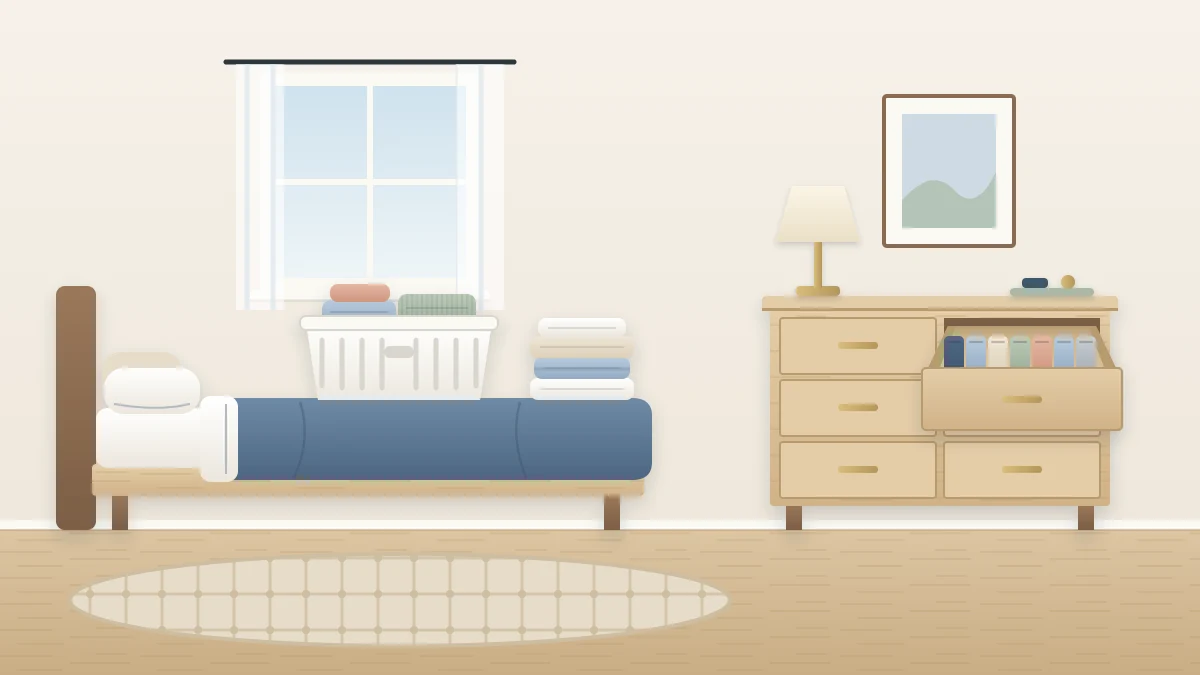
- Put all laundry away. Clean clothes go into drawers the same day they come back, not into a basket that sits on the floor until midweek.
That is the whole weekly list. If it regularly takes much longer than a short session, treat that as information about the system, not about you; the signs further down will help you find the cause.
Monthly: look inside the closed storage
Surfaces show their state every day. Drawers and boxes hide theirs, so they need a planned look. Once a month suits many households.
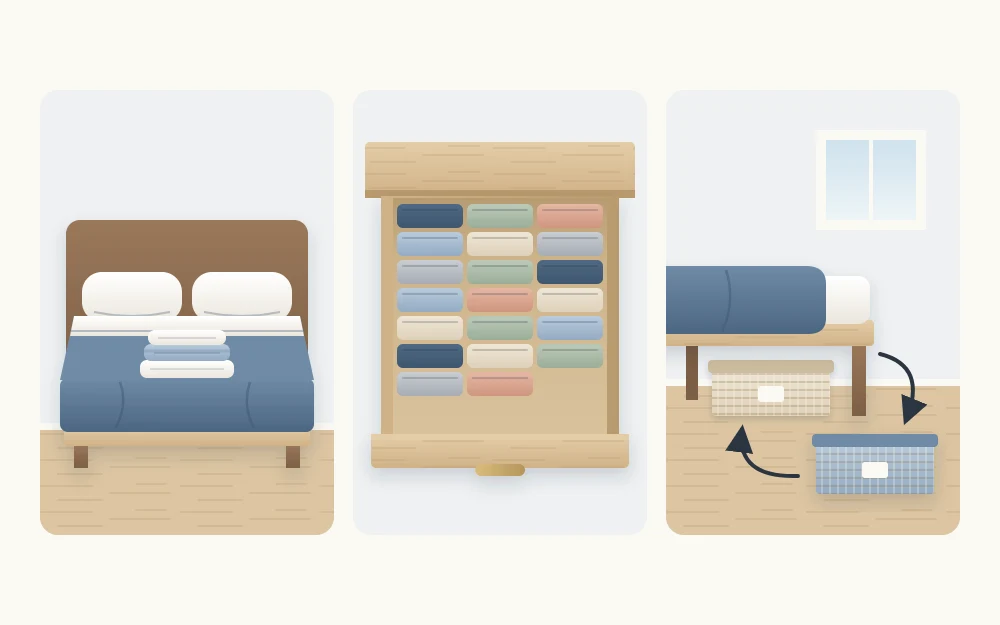
- Open each drawer and straighten the rows. Refold what has slumped and move anything that drifted into the wrong drawer.
- Check the nightstand drawer. It is small and close to hand, so it gathers receipts, loose cables and things from pockets faster than any other space.
- Look under the bed. Slide the containers out, retrieve whatever has rolled underneath, and clean the floor. The steps are set out in the guide to keeping under-bed storage clean.
- Deal with the “maybe” and donate boxes. If nothing was pulled out of the “maybe” box during the month, it is probably ready to go. Take the donate box out of the house instead of letting it settle into a corner.
Seasonally: rotate and review
Two to four times a year, depending on your climate, the contents of the room change. That is the moment for the larger checks.
Rotate clothes and bedding. Move what you are about to wear into the easiest drawers and send the off-season pieces to deeper storage. Store textiles clean and completely dry in closed containers. The full method is in the guide to seasonal clothes storage.
Review what was not used. As you pack the outgoing season away, notice what you never reached for. Anything unworn for a whole season is a candidate for the donate box.
Vacuum under and behind furniture. Pull lighter pieces forward where you can do so easily. For a tall dresser, bookcase or wardrobe that is anchored to the wall, leave the anchor in place as its maker instructs and clean around and beneath it.
Check the containers. A bin chosen a year ago may now be half empty or badly overfilled. Swap sizes around the room before buying anything new.
Signs the system needs adjusting, not more effort
When the same problem returns every week, more tidying is rarely the fix. The setup needs to change.
- A home that is always overflowing. Either there is too much in the category or the space given to it is too small. Reduce the contents or give it a bigger home.
- A pile that keeps coming back. The home is in the wrong place. Clothes that land on a chair every night are a request for hooks or a hamper beside that chair.
- A container nobody opens. Its contents are unneeded, or it is too awkward to reach. Empty it, decide on what is inside, and use the container somewhere else.
Several of these patterns are covered in more detail in the list of common bedroom organization mistakes.
Tip
Move the home toward the pile, not the pile toward the home. If things keep landing in one spot, that spot is where the storage should be.
One in, one out
Drawers and shelves hold a fixed amount. The one-in, one-out habit keeps the amount steady: when a new sweater arrives, an older one leaves; when a new book joins the bedside stack, a finished one goes to another shelf or out of the house.
It works best for clothes and books, the two categories that grow quietly. Treat it as a guide, not a strict rule. The point is to notice when a full drawer is being asked to take one more thing, and to make the decision then instead of at the next big clear-out.
When a week gets missed
Skipped weeks are normal. Pick up at the next one and do the weekly list only; there is no need to catch up on everything at once. If the room has drifted a long way, do the surfaces and the laundry first, since those two change how the room works the fastest.
Frequently asked questions
How often should a bedroom be tidied to keep it organized?
Many people find that a few minutes a day plus one short weekly session is enough. The weekly session covers strays, worn-once clothes, surfaces and laundry. Add a monthly look inside drawers and under the bed, and a seasonal rotation. These intervals are suggestions, so adjust them to your household.
Why does a bedroom get messy again so quickly?
Usually because a home is too small, too full or in the wrong place. If a pile returns to the same spot every week, put storage at that spot. If a drawer always overflows, reduce what is in it or give the category more room. More tidying alone seldom fixes a setup problem.
What is the one-in, one-out habit?
When something new comes into the room, something similar leaves. A new sweater replaces an older one; a new book replaces a finished one. It keeps the amount in your drawers and on your shelves steady. Use it as a guide for clothes and books, not as a strict rule.