Bedroom Clutter Hotspots: The Chair, the Floor and the Dresser Top
Why the same piles keep forming on the bedroom chair, the floor and the dresser top, and a specific fix for each one that gives the items a home where they actually land.
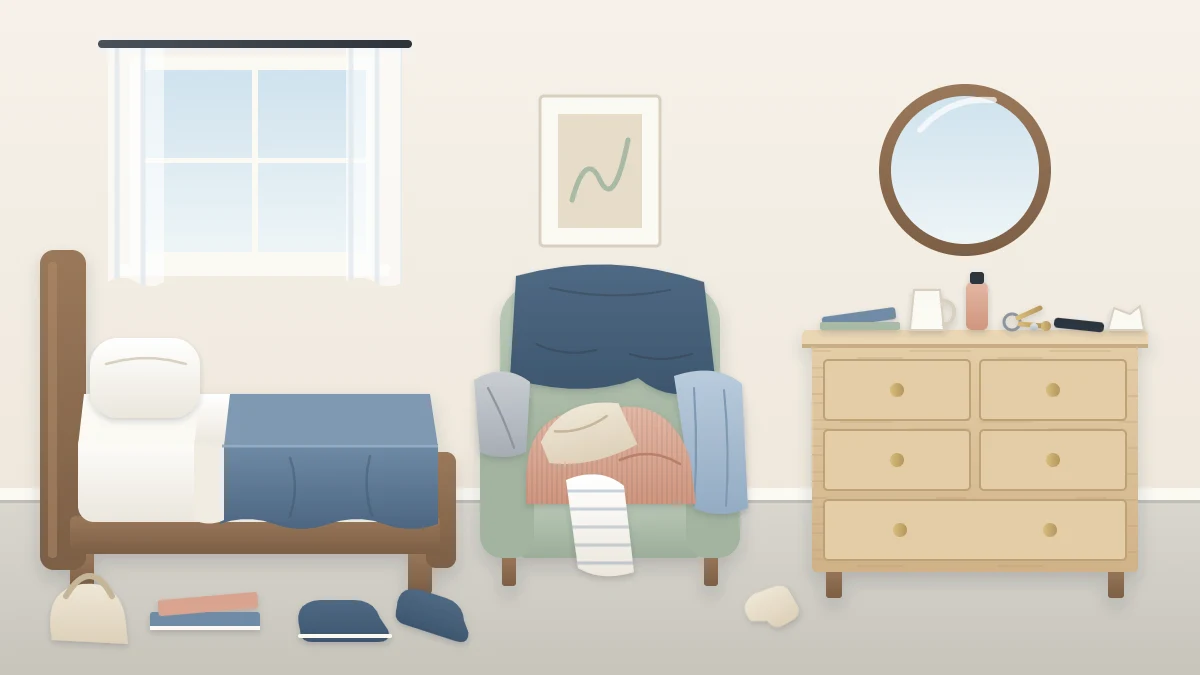
Most bedrooms have a few places where things pile up again within days of being cleared: the chair, the floor by the bed, the top of the dresser. These bedroom clutter hotspots are not a sign of carelessness. They are useful information about how the room really gets used.
A pile forms when the things in it have no home, or when the home is too far away or too awkward to use at the moment you are holding the item. Clearing the pile treats the symptom. Fixing the home, right where the pile forms, is what stops it from coming back.
Why the same piles keep coming back
Every hotspot has one of three causes, and it helps to name which one you are dealing with.
- The home is missing. Clothes worn once are the classic case: too clean for the hamper, not fresh enough for the drawer, so they go on the chair.
- The home is too far away. If the place for your bag is across the room, the bag stops at the first flat surface near the door.
- The home is too hard to use. A drawer that is overfull, a lid that has to be lifted or a hanger that has to be found adds a step, and at the end of the day one extra step is enough.
| Hotspot | Why it happens | Fix |
|---|---|---|
| The chair | Worn-once clothes have no home | A few hooks, a valet stand or one bin, with a limit |
| Floor by the bed | Books, bags and shoes are dropped where you sit | A basket or low shelf; a shoe spot on your real route |
| Dresser top | Pockets are emptied there every night | A landing tray; everything else moves out |
| Foot of the bed | Clean laundry waits to be put away | Fold beside the drawers; park the basket elsewhere |
| Hamper lid and behind the door | A lid adds a step; hidden space collects strays | An open hamper; hooks with one job each |
The chair
The bedroom chair collects worn-once clothes: the jeans you will wear again tomorrow, the sweater that was on for an hour.
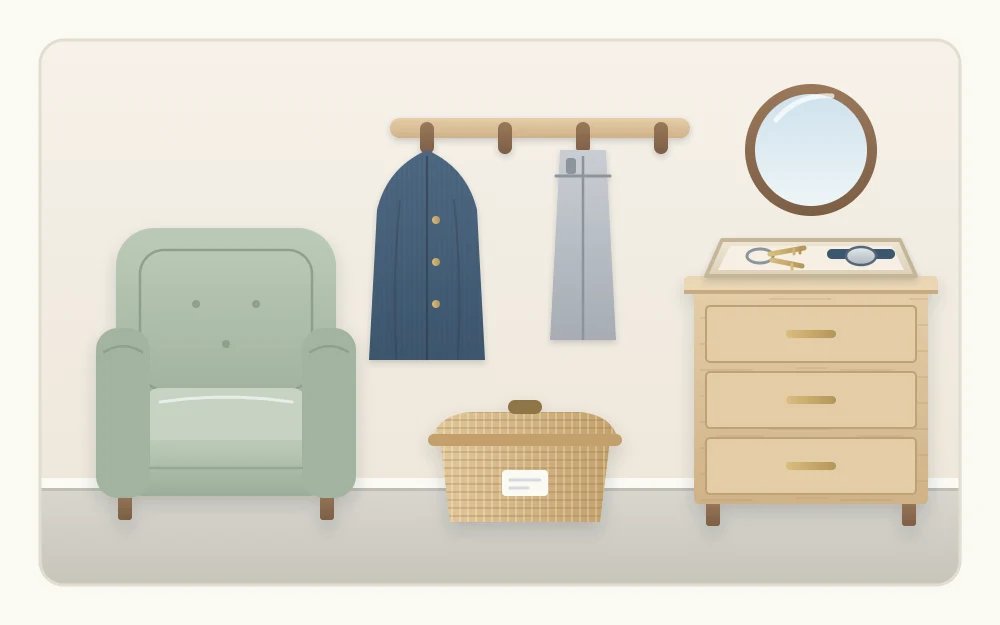
The fix is to give them a real home that is just as easy to use as the chair:
- a short row of wall hooks or a peg rail near where you undress;
- a valet stand, which takes one outfit and no wall fixing;
- one open bin, labeled if that helps, for items that can be folded.
Then set a limit. Three or four hooks means three or four items; when they are full, something goes back in a drawer or into the hamper. For any hooks or rails fixed to the wall, follow the product instructions, use fixings suited to the wall type and check the lease if you rent. More ways to keep clothes outside the drawers are in the guide to bedroom clothes storage ideas.
The floor by the bed
Whatever you are holding when you sit down on the bed tends to end up on the floor beside it: the book you were reading, a bag, the shoes you kicked off. Each needs its own answer.
- Books and magazines: a small basket or a low shelf within reach of the bed, sized for a few and no more.
- Bags: a hook or a fixed spot near the door, where the bag is picked up on the way out.
- Shoes: look at where they come off. If that is always beside the bed, move the shoe spot there, as a tray or a low rack, or build the habit of taking them off at the entry and keep only slippers by the bed.
The dresser top
The dresser top is flat, waist-high and on the way to bed, so it receives whatever was in your pockets: keys, coins, receipts, a watch, earbuds.
Give the daily items a landing spot, which can be a single tray or shallow dish. What fits in the tray stays; receipts and coins get emptied out weekly. Then clear everything from the surface that is not used every day.
The foot of the bed
Clean laundry arrives in the bedroom in a basket, the basket lands on the bed, and at bedtime it moves to the floor.
Shorten the path. Carry the basket to the dresser, not the bed, and fold straight into the open drawers, so each piece is handled once.
Return the empty basket to the laundry area right away. It should never live at the foot of the bed.
The nightstand, the hamper and behind the door
- The nightstand. It collects cups, books and cords because it is the nearest surface to the bed. Limit it to what you use from bed, and take cups out with you each morning.
- The top of the hamper. Clothes on the lid mean the lid is in the way. An open hamper, or one with a lid you can push open with one hand, removes the step.
- Behind the door. This hidden corner gathers bags, shoes and things on their way somewhere else. Either give it one clear job, such as hooks for bags and robes, or keep it empty so the door opens fully.
A method for any new pile
Hotspots shift. When a new pile appears, treat it as a question, not a failure.
- Look at what is in the pile. It is usually one or two kinds of thing, not a random mix.
- Ask where each kind is supposed to go. If there is no answer, the home is missing.
- Ask why it did not get there. Too far, too full or too many steps?
- Put the home where the pile is, or make the existing home easier to use: fewer items in it, no lid, a lower shelf.
- Set a limit so the new home cannot turn into a neater pile.
If a pile turns out to be mostly things you do not use at all, it is a decluttering job, and the guide on how to declutter a bedroom shows how to work through it.
Keeping hotspots clear
Even well-placed homes need a moment of use each day. A few minutes every evening to return things to their hooks, tray and hamper keeps small piles from growing, and a short daily bedroom reset routine lays out the tasks. If a pile still returns after a few weeks, the home is wrong for the way you use the room, so move it again.
Frequently asked questions
Why do clothes always end up on the bedroom chair?
Usually because clothes worn once have no home. They are too clean for the hamper and not fresh enough for the drawer, so the chair takes them by default. A few hooks, a valet stand or one open bin near where you undress gives them a place that is just as easy to use.
How do I keep the top of my dresser clear?
Give the things from your pockets a single small tray or dish as a landing spot, and let only what fits in it stay. Empty receipts and coins weekly. Then move everything that is not used daily, such as cosmetics and paperwork, into a drawer or out of the bedroom.
What if a new pile appears somewhere else?
Treat it as information. Look at what the pile contains, ask where those things are meant to go and why they did not get there: too far, too full or too many steps. Then put a home where the pile forms, or make the existing home easier to use, and set a limit.