Organizing Bedroom Accessories: Jewelry, Belts, Bags and Scarves
Small accessories tangle because they share one drawer. Here is a home for each type, from jewelry and watches to belts, scarves, hats and bags, using a dresser, a shelf and a few hooks.
Accessories are the smallest things in a bedroom and often the hardest to keep in order. A sweater has an obvious drawer. A single earring, a belt and a long scarf do not, so they end up tangled together in one compartment or spread across the dresser top.
The key to organizing bedroom accessories is shape. These items are small, numerous and oddly formed, so each type needs a home that fits it instead of one catch-all drawer. This guide goes type by type and stays with furniture most bedrooms already have: a dresser, a shelf and a few wall hooks.
Edit before you organize
Gather every accessory you keep in the bedroom and lay it all out on the bed, grouped by type: jewelry together, belts together, scarves together.
Take out anything broken, any earring that has lost its partner, and the pieces you pass over every time. If something only needs a repair, give it a separate small bag and a date to deal with it. What remains is what needs a home, and a rough count of each type tells you how large that home has to be.
Three principles that keep small things in place
- Store by how often you wear it. Daily pieces go where your hand lands without opening anything. Occasional pieces go in a drawer. Things worn a few times a year can sit on a higher shelf.
- One category per container. A tray that holds only watches stays tidy. A tray that holds watches, hair ties and loose coins turns back into a jumble within a week.
- Match the home to the shape. Long things need length, round things need a wall to roll against, and soft things need sides to stand between.
Jewelry, watches and glasses
Everyday jewelry
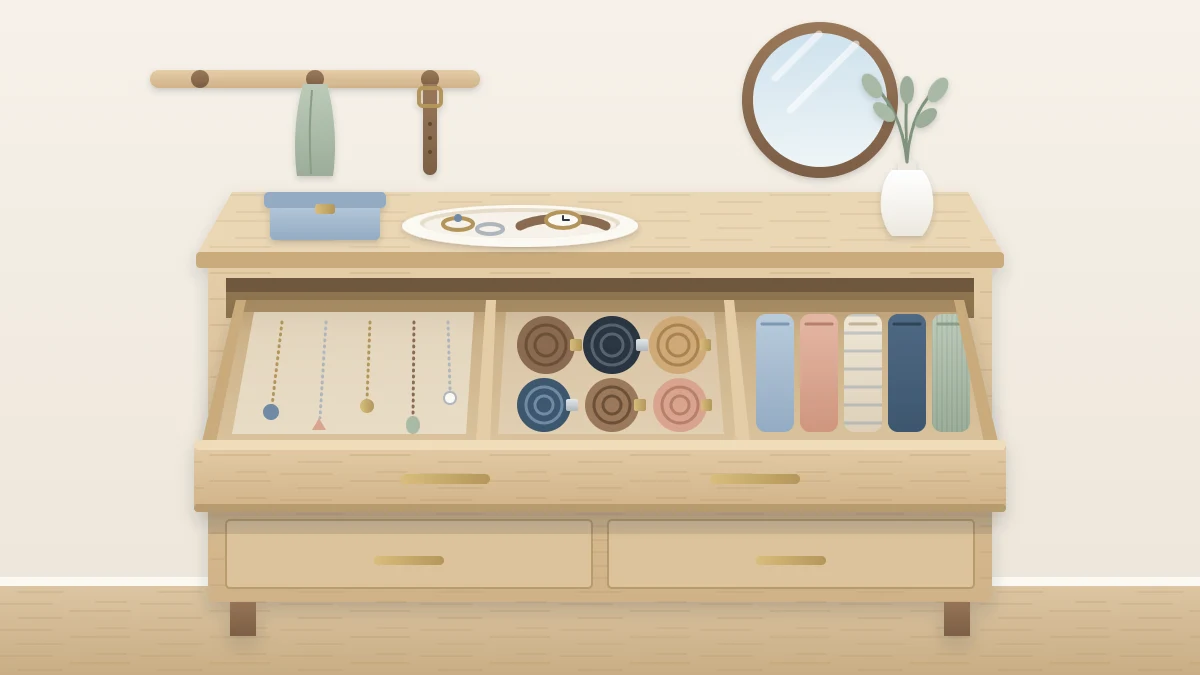
The ring, watch or earrings you wear most days need a small dish or tray in the exact spot where you take them off, which for many people is the dresser top. Keep it small on purpose. A dish that holds four or five pieces cannot quietly become storage for everything else.
Everything else
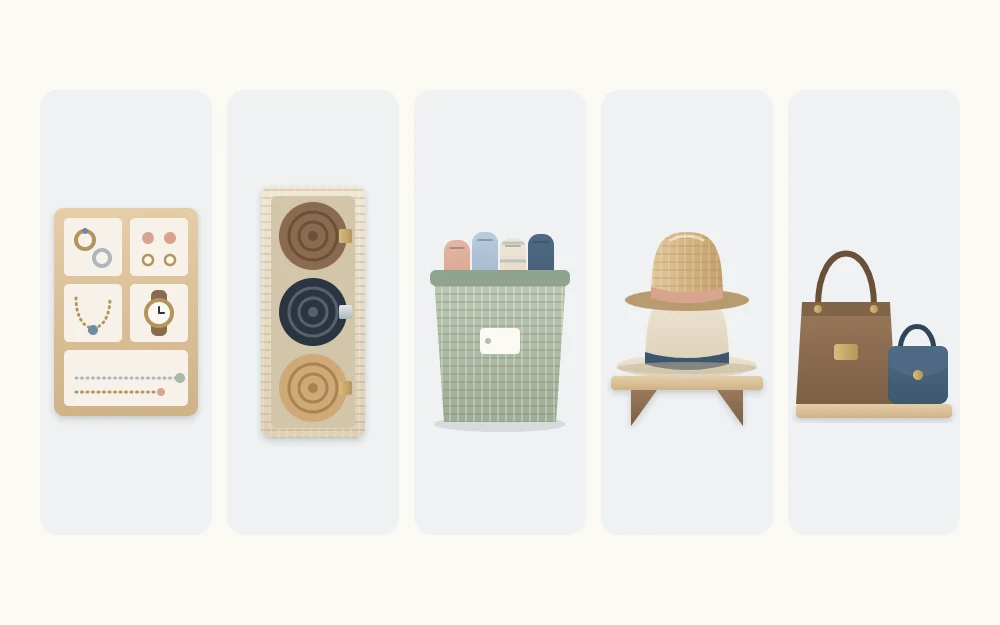
Other jewelry does best in a shallow divided tray inside a drawer, usually the top one. Lay each necklace straight in its own narrow compartment with the clasp fastened, so chains never touch each other. Earrings stay in pairs in the smallest sections, and bracelets and rings take the squarer ones.
Measure the inside of the drawer before choosing a tray, including the height. As an example, a top drawer may be only about 3 in (8 cm) deep inside, which rules out many taller boxes, so check your own. If the drawer is already shared with clothes, the guide to arranging dresser drawers by category explains how to free a section for accessories.
Watches and glasses
Watches and spare glasses or sunglasses are best laid flat in a tray with a soft lining, such as felt or fabric, so faces and lenses do not rub against hard edges or each other.
Belts and scarves
Belts tangle because they are long and stiff. Rolling fixes both problems: roll each belt from the buckle end and stand the rolls side by side in a divided drawer section, where every one is visible from above. If you have no spare drawer, hang belts by the buckle from a row of hooks instead, a few to a hook at most.
Scarves are soft and slide into a heap unless something holds them. Three arrangements work well:
- Folded into upright rectangles and stood in a bin, like files, so you can see every one.
- Rolled and lined up in a drawer section, which suits lighter fabrics.
- Looped over a hanger, a few to a hanger, for long scarves you wear often.
You do not need to buy organizers for any of this. Small boxes work, and so does a grid of homemade cardboard drawer dividers cut to the size of your belts and scarves.
Good to know
Wall hooks and adhesive hooks hold only what the product states. Follow the product instructions, use fixings suited to your wall type, and check your lease before drilling if you rent.
Hats and bags
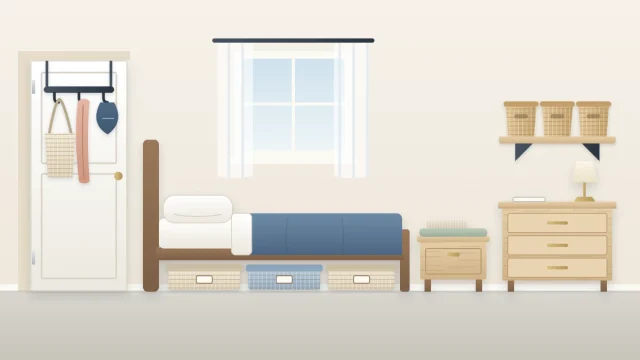
Hats with a firm shape can be stacked a few high on a shelf, similar shapes together, with the sturdiest at the bottom. Keep the stack short so the lowest hat is not flattened and you can lift one out with one hand. Soft caps and beanies are easier on hooks or folded into a bin.
Bags keep their form when they stand upright on a shelf, side by side like books, instead of lying in a pile. Stuff each one lightly with tissue paper or a clean T-shirt so it does not slump, and tuck the straps inside. Small bags and pouches can nest inside larger ones, which saves a surprising amount of shelf. The guide to arranging open bedroom shelves covers how to assign shelves by reach and keep heavy things low.
Hair accessories and other small items
Hair ties, clips, pins, cufflinks and collar stays are the items most likely to scatter. Give each kind a small lidded box, and choose shallow boxes so nothing is buried under a second layer.
Accessory homes at a glance
| Accessory | Good home | What to avoid |
|---|---|---|
| Everyday jewelry | Small dish where you take it off | A large tray that collects everything |
| Necklaces and chains | Shallow divided tray, laid straight | One shared compartment or a pouch |
| Watches and glasses | Lined tray, one slot each | Loose in a drawer with keys or coins |
| Belts | Rolled in a divided section, or on hooks | Coiled together in a heap |
| Scarves | Folded upright in a bin, or rolled | A deep pile where only the top one shows |
| Hats | Short stack on a shelf, or hooks | Tall stacks and tight spaces that crush |
| Bags | Upright on a shelf, lightly stuffed | Piled on the floor or on a chair |
| Hair accessories | Small lidded boxes, one kind each | Loose on the dresser top |
Keeping accessories in order
The setup lasts when each home has a limit. When a compartment is full, a new piece means an old one leaves, or the category gets a second look.
Put pieces back as you take them off, which takes seconds when the home is close by. If one type keeps landing on the dresser top anyway, its home is probably too far away or too fiddly to open, and moving it nearer will do more than tidying again.
Frequently asked questions
How do I stop necklaces from tangling?
Keep each necklace apart from the others. Fasten the clasp and lay the chain straight in its own narrow compartment of a shallow divided tray. Chains tangle when several share one space or are dropped into a pouch together, so separate compartments matter more than the kind of tray you use.
Where should I keep accessories if my dresser has no spare drawer?
Use a shelf and a few hooks. Small lidded boxes on a shelf can hold jewelry and hair accessories, a bin can hold folded scarves, and belts can hang by the buckle from hooks. Follow the product instructions for any hook, and keep one category in each container.
How should I store handbags so they keep their shape?
Stand them upright on a shelf, side by side, with the straps tucked inside. Stuff each bag lightly with tissue paper or a clean T-shirt so it does not slump. Smaller bags and pouches can sit inside larger ones to save room, as long as you remember where they are.