Organizing a Shared Bedroom: Dividing Space Fairly
A step-by-step way for two people to share one bedroom: divide the dresser, bedside, shelves and under-bed space into clear shares, and agree simple rules for the zones you both use.
Two people in one bedroom means two sets of clothes, two bedtime routines and two ideas of what “tidy” means. Most of the friction comes from things without a clear owner: a drawer both people use, a chair that collects everyone’s clothes, a nightstand that slowly fills with someone else’s belongings.
Organizing a shared bedroom works when ownership of space is explicit. Whether you share with a partner, a sibling or a roommate, the steps are the same: work out what each person needs in the room, divide the storage into clearly bounded shares, and agree a few rules for the parts you both use.
List what each person keeps in the room
Before moving anything, each person writes down what they need to keep in the bedroom: everyday clothes, sleepwear, shoes, books, chargers, grooming items, work or study things. Keep the lists by category, not by item.
The lists do two things. They show where the amounts are uneven, which is normal and worth saying out loud. They also show what could live in another room, which is the cheapest storage you will find.
Divide the storage you already have
Go through the room one piece of furniture at a time and give each person a share with a visible edge: this drawer, that shelf, this side. Vague arrangements such as “we both use the top drawer” are where the overlap starts.
The bed and the bedside
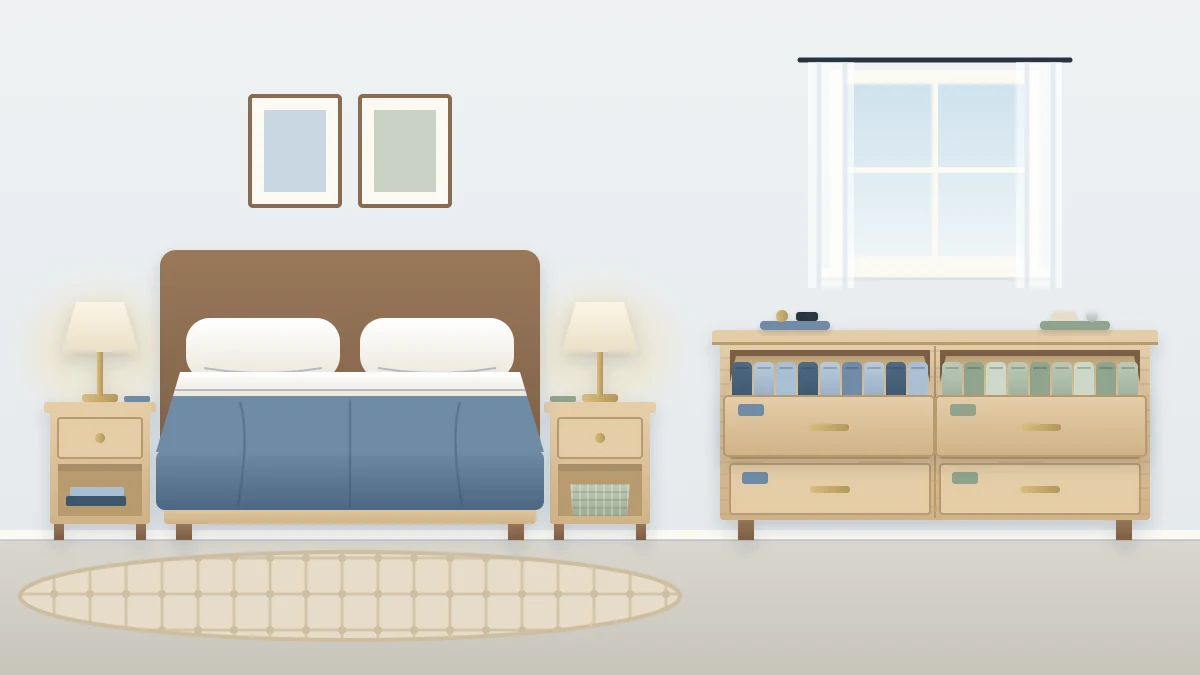
Each person has their own side of the bed and their own nightstand. If there is room for only one nightstand, the other person gets a bedside pocket that hangs from the frame or a small shelf fitted according to the product instructions. What sits on a bedside belongs to that person alone.
A shared dresser
Split a dresser top to bottom, left and right, when its drawers allow it. If it has a single column of drawers, alternate them, so that nobody ends up with all the low drawers and both people get one at a comfortable height. Small top drawers are easy to divide one each.
If one person has more clothes, a split that follows the amounts is fairer than a strict half. Agree it openly and revisit it later. Ways to store the overflow are in the guide to bedroom clothes storage ideas.
Shelves, bins and the space under the bed
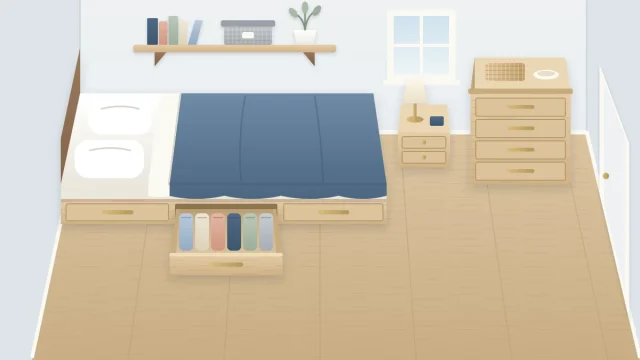
Give each person their own shelf or their own bins on a shared shelf. Under the bed, the natural split is by side: containers that pull out on your side are yours. If the bed stands against a wall and only one side is reachable, split it front and back and put the less-used containers at the far end.
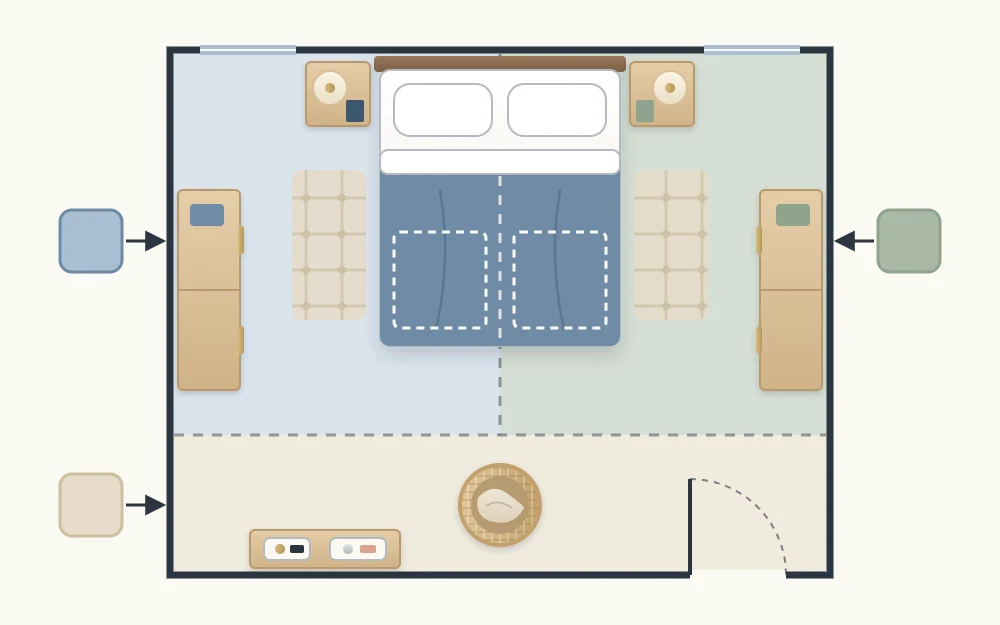
How to divide each area
| Area | How to divide it |
|---|---|
| Bed and bedside | One side and one nightstand or bedside pocket each |
| Dresser | Left and right columns, or alternating drawers from top to bottom |
| Shelves | A shelf each, or bins of your own on a shared shelf |
| Under the bed | By side; front and back if only one side is reachable |
| Hooks | A fixed set each, in the same order as the sides of the bed |
| Hamper, landing spot, floor | Shared, with rules you agree together |
Agree the shared zones and their rules
Some parts of the room cannot be split. Treat them as shared zones with one or two plain rules each, agreed by both people. The idea of a zone, an area with one job, is explained in the guide to bedroom storage zones.
- The hamper. One shared hamper is simplest if you wash together; one each is simpler if you do not. Decide who empties it and when.
- The landing spot. Keys, wallets and bags need a tray or hook each, even if they sit side by side. A single shared tray tends to turn into a mixed pile.
- The floor. The floor is a walkway for both people, so the rule is short: nothing is stored on it outside a container.
Give each person a worn-once spot
Worn-once clothes are the usual source of the shared chair pile. Give each person a spot of their own: a couple of hooks, one end of a peg rail or a valet stand. Fit hooks and rails following the product instructions, with fixings suited to the wall type, and check the lease first if you rent.
When the spots are separate, each person can see what is theirs to deal with, and one full hook does not bury the other.
When your tidiness standards differ
It is common for one person to be bothered by things the other does not notice. Trying to bring both people to the same standard everywhere rarely lasts. Two agreements usually work better.
- Set a minimum for the shared areas. For example: the floor clear, the bed usable, the shared surfaces free of dishes. Keep the list short enough that both people will meet it.
- Leave each other’s closed storage alone. What happens inside a person’s own drawers, bins and nightstand is their business. Do not reorganize it for them.
Tip
Lidded bins and drawers help when standards differ: the contents can be as loose as their owner likes while the room still looks calm from the doorway.
When your schedules differ
If one of you gets up or goes to bed much earlier, organize around the quiet hours. The early riser can set out the next day’s clothes the evening before, in the top of their own dresser section, on their worn-once hook or outside the sleeping area altogether, such as in the bathroom or hallway.
Keep whatever is needed in the dark easy to reach without opening several drawers: one drawer, one hook, one bag by the door.
When the storage is not enough for two
If the shares are settled and things still do not fit, declutter together before adding furniture. Each person edits their own belongings; neither decides for the other.
If you do add a tall piece such as a wardrobe, a tall dresser or a bookcase, anchor it to the wall as its maker instructs and keep the heaviest things in the lowest drawers and shelves. For tight rooms, the guide to small bedroom organization has more ways to find space.
This guide covers two adults or older siblings sharing a room. Bunk beds and young children’s rooms raise their own questions and are outside it.
Frequently asked questions
How do two people share one dresser fairly?
Split it left and right if it has two columns of drawers. With a single column, alternate the drawers so each person has one at a comfortable height and nobody gets only the low ones. If one person owns more clothes, agree a split that follows the amounts and review it later.
What if my roommate or partner is messier than I am?
Agree a short minimum for the areas you both use, such as a clear floor and clear shared surfaces. Then leave each other's own drawers, bins and nightstand alone. Closed storage helps, because its contents can be loose without affecting how the shared parts of the room work.
What should we do if there is not enough storage for two people?
Declutter together first, with each person editing only their own things, and move anything that could live in another room. Add furniture only after that. Measure before buying, and anchor any tall piece to the wall following the maker's instructions, with heavy items kept low.