Awkward Bedroom Corners: Storage for Alcoves, Slopes and Gaps
How to measure and use the odd spaces in a bedroom: empty corners, alcoves, the low side of a sloped ceiling, narrow gaps, the wall under a window and the space behind the door.
Most bedrooms have at least one spot that standard furniture ignores: a corner the dresser stops short of, a recess in the wall, the low side of a sloped ceiling, a hand-width gap next to the wardrobe. These awkward bedroom corners tend to collect a chair, a pile or nothing at all.
They are worth a second look, because each one can usually take a single job off the rest of the room. The approach is the same every time: measure the space first, then match a storage type to its shape instead of forcing a piece you already own into it.
Measure before you choose anything
Awkward spaces are rarely the size they appear. Walls in older buildings are often out of square, baseboards steal depth at floor level, and a recess can be noticeably narrower at the back than at the front.
- Width: measure at the floor, at waist height and near the top, and at the front and back of a recess. Work from the smallest figure.
- Depth: measure from the wall and again from the baseboard, since furniture sits against the baseboard.
- Height: under a slope, measure the height at the low wall and note how far into the room you have to go before you can stand upright.
- Movement: open the nearest door, drawer and window fully and mark how far each one swings or slides.
Write the numbers down and take them with you. A piece that is a fraction too wide does not fit at all.
Empty corners
A bare corner between two walls is the easiest of these spaces to use, because it has full height and nothing swings into it. What suits it depends on what the room is short of.
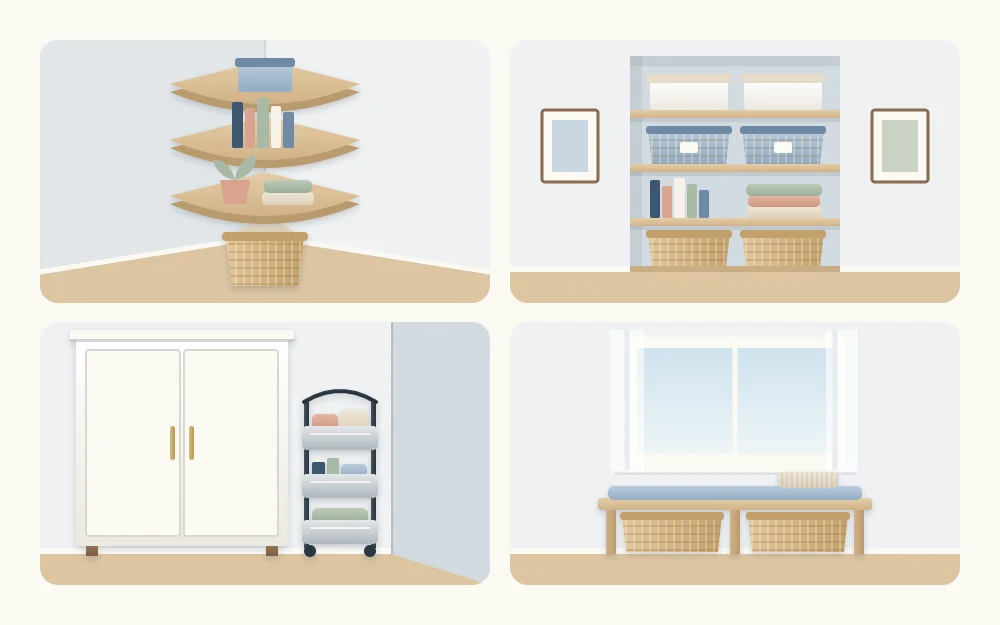
- A corner shelf unit that stands on the floor gives several small shelves for books, baskets or folded items.
- A stack of corner wall shelves keeps the floor free. Fit them with fixings suited to the wall type and load them within the limits the product states. If you rent, check the lease before drilling.
- A tall narrow unit uses the height. Anchor it to the wall following the maker’s instructions and put the heaviest things on the lowest shelves.
- A hamper or a floor basket is the simplest answer of all. Nothing needs fitting.
Going upward is often the better use of a corner in a tight room; the guide to vertical storage in a small bedroom covers how to plan it by height.
Alcoves and recesses
A recess has three walls, which makes it a ready-made frame for storage. The best result usually comes from filling its width as closely as you can.
Shelves cut to the width, or adjustable shelves set to it, turn the recess into open storage; bins on the shelves keep small things together. A dresser or chest of drawers that fits the recess is the other common choice. Leave a little room at each side so it slides in without scraping, and check that the drawers open fully past anything on the adjoining wall.
A hanging rail across a recess can hold a few garments if clothes storage is your shortage, fitted as its instructions describe.
Under a sloped ceiling or eaves
A slope divides the room into a short side and a tall side. The plan is to give each side what it can take.
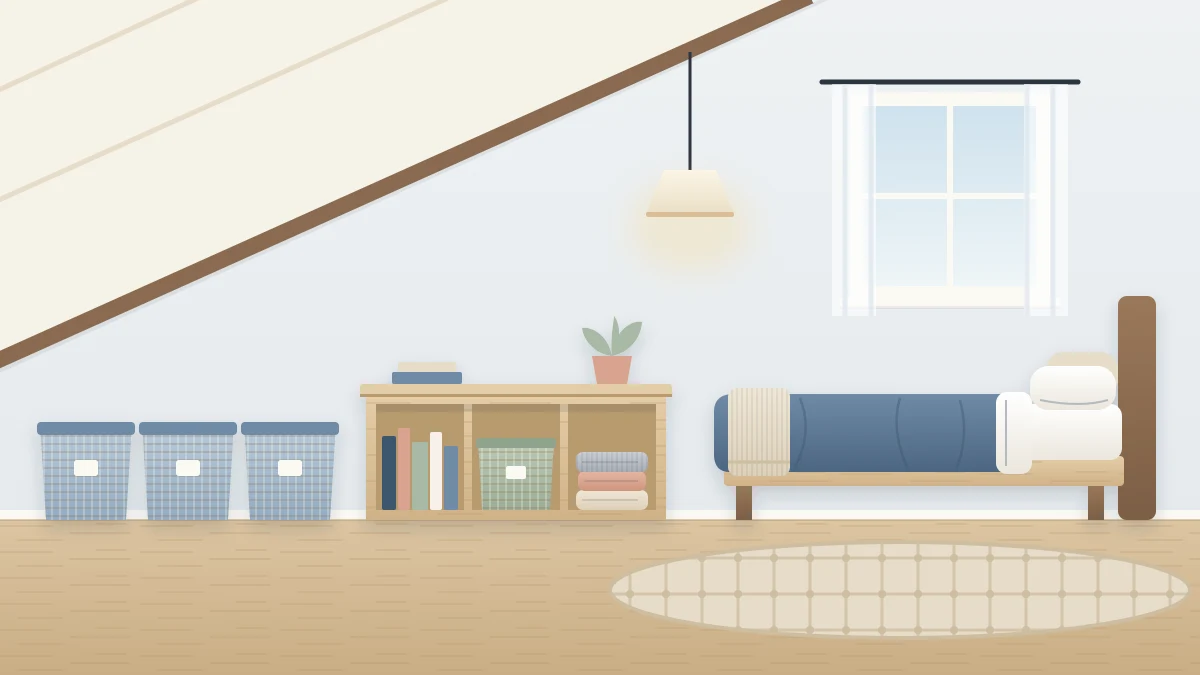
On the short side, keep everything low: a low shelf, a row of low bins, a low dresser, or lidded boxes on the floor. Bins that pull forward are easier than deep shelves, because you do not have to lean in under the slope to reach the back.
Keep the tall side for standing and for taller furniture such as a wardrobe. A bed can often sit with its head toward the low wall, provided you can still sit up comfortably; try it before committing.
Narrow gaps beside a wardrobe or the bed
A gap between a wardrobe and the wall, or between the bed and the wall, looks too thin to matter. It often is wide enough for one of three things.
- A slim rolling cart pulls out like a drawer and slides back out of sight. Measure the cart at its widest point, which is usually the wheels or handle.
- A narrow shelf standing in the gap holds books or small baskets. Even a narrow unit should be anchored as its maker instructs if it is taller than it is deep.
- Hooks for bags on the side wall use a gap too thin for furniture. Follow the product instructions for adhesive or screw-in hooks and hang only what they are rated for.
Under a window and behind the door
The wall under a window suits a low bench or a low shelf that stays below the sill, so the window still opens and can be reached. Look first for a radiator, a baseboard heater or a floor vent. If one is there, leave that stretch of wall empty.
The wall behind the door is the other overlooked surface. Hooks there hold a robe, a bag or tomorrow’s outfit, as long as the door still opens fully with everything hanging.
What fits where
| Awkward space | What fits | What to check |
|---|---|---|
| Empty corner | Corner shelves, tall narrow unit, hamper, floor basket | Tall units anchored; wall shelves fitted as instructed |
| Alcove or recess | Shelves to the width, a dresser that fits | Width at front and back; drawers open fully |
| Under a slope | Low shelf, low bins, low dresser | Height at the low wall; reach to the back |
| Narrow gap | Slim rolling cart, narrow shelf, hooks | Narrowest width; room to pull the cart out |
| Under a window | Low bench or low shelf | Below the sill; clear of heaters and vents |
| Behind the door | Hooks | Door opens fully |
Three rules for every odd space
- Give it one job. A corner that holds “the hamper” stays tidy; a corner that holds “extra stuff” fills up again.
- Keep doors, drawers and walkways clear. Storage that blocks the route to the bed costs more than it gives.
- Leave some corners empty. Not every gap has to hold something. If the room already has a home for everything, an empty corner is fine.
For the wider plan in a tight room, see the guide to small bedroom organization, and for more storage types to match against your measurements, browse the full list of bedroom storage ideas.
Frequently asked questions
What can I put in an empty bedroom corner?
Choose by what the room lacks. A hamper or floor basket needs no fitting and gives worn clothes or blankets a home. Corner shelves hold books and baskets. A tall narrow unit uses the height, and should be anchored to the wall following the maker's instructions with heavy items on the lowest shelves.
How do I use the low side of a sloped ceiling?
Keep storage low there: a low shelf, a row of bins or lidded boxes on the floor. Bins that pull forward are easier to use than deep shelves, since you do not have to lean in under the slope. Save the taller side of the room for standing and for taller furniture.
How should I measure an alcove for furniture?
Measure the width at several heights and at both the front and the back, because walls are often out of square. Measure the depth from the baseboard as well as the wall. Use the smallest figures, and leave a little room at each side so the piece slides in.