Small Bedroom Organization: Making a Tight Room Work
Principles for a bedroom where the bed takes most of the floor, in priority order: own less in the room, keep the floor clear, use the under-bed space and height, and place furniture so drawers and walkways work.
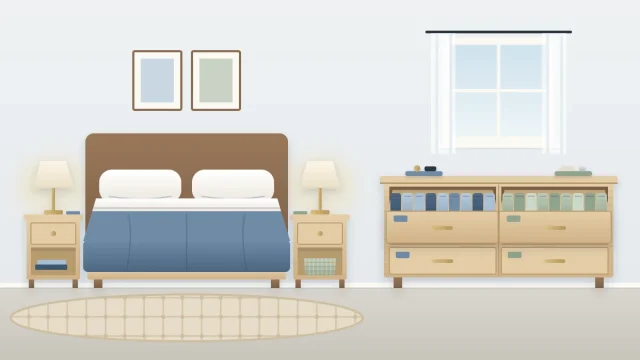
In a small bedroom the bed takes most of the floor, and everything else has to fit around it. There is no spare corner for overflow, so a few extra things are enough to make the room hard to move through.
Small bedroom organization is less about clever products than about priorities. The principles below are in order of how much difference they usually make, starting with the ones that cost nothing. One note on scope: making a room look larger with decor is a different topic. This guide is only about where things are kept and how the room is used.
Own less in this room
The first principle is the least exciting and the most effective: a small bedroom keeps only bedroom things. That means what you need for sleeping and dressing, and whatever else the room truly has to do.
Walk around and look for things that are stored here only because there was a gap: paperwork, hobby supplies, spare household items, boxes that were never unpacked. Each one that moves to another room, or leaves the home, frees space that no organizer could create.
Keep the floor clear
Visible floor is what makes a small room usable. You need it to walk, to open drawers and to make the bed, and every bag, stack or basket left on it takes some of that away.
Treat the floor as a place for furniture legs and feet, not storage. Anything that currently lives on the floor needs a home that is off it: a hook, a drawer, a shelf or a container under the bed. If something keeps returning to the floor, its home is probably too far away or too awkward, and that is the thing to fix.
Use the space under the bed deliberately
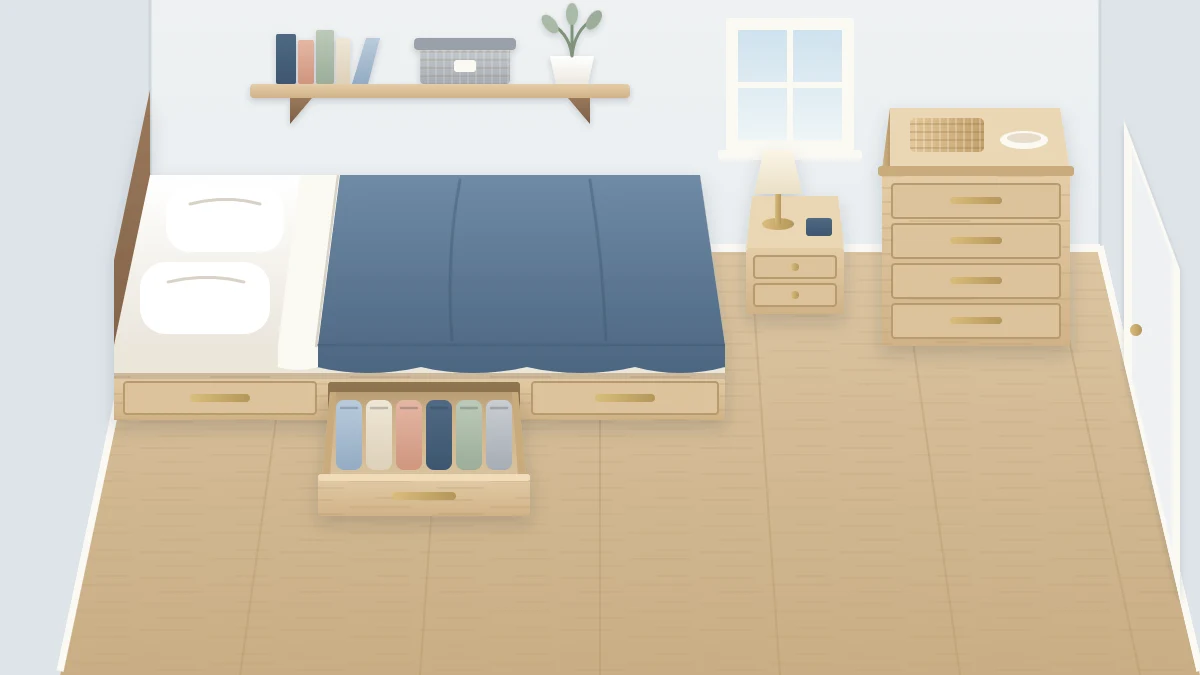
The bed covers the largest patch of floor in the room, which makes the space beneath it the largest storage area you have. Used on purpose, it holds out-of-season clothes, spare bedding and other things you need only now and then, in closed containers that slide out easily.
Used by accident, it becomes a place where loose things disappear. Measure the clearance and choose containers to fit; the guide to under-bed storage options compares the types. Do not block a floor vent or push containers against a baseboard heater.
Use height and the backs of doors
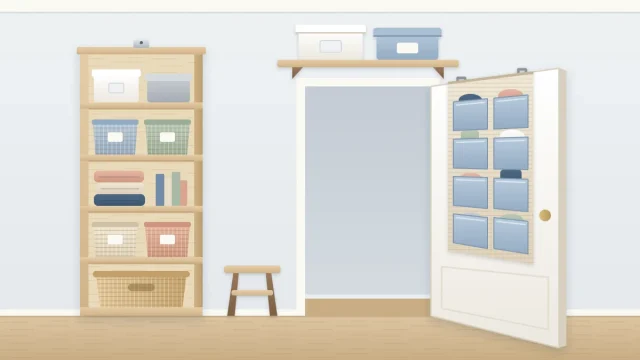
When the floor is full, the walls and doors are the remaining space. A shelf above a dresser, a tall narrow shelf unit in place of a wide low one, and hooks on the back of the door all add storage without taking a step of floor.
Put light and rarely used things highest and heavy things low. For wall-mounted and over-door storage, follow the product instructions, use fixings suited to your wall type and stay within the limits the product states. There is much more on this in the guide to vertical storage in a small bedroom.
Good to know
Tall furniture can tip. If you use a tall dresser, shelf unit or wardrobe, anchor it to the wall following the furniture maker’s instructions and keep the heaviest items in the lowest drawers or shelves. The Anchor It campaign from the U.S. Consumer Product Safety Commission explains more.
Choose furniture that does two jobs
In a small room, adding a piece of furniture to solve a storage problem often creates a floor problem. It usually works better to make each piece you already need do more.
- A bed with drawers in its base, in place of a plain frame plus a separate chest.
- A storage bench at the foot of the bed, if there is room to walk past it, for sitting and for bulky items.
- A nightstand with drawers instead of an open table, so the bedside holds more in the same footprint.
Before bringing in anything new, ask which existing piece it replaces.
Prefer closed storage
Open shelves and racks show everything on them, and in a small room everything is always in view. Drawers, lidded boxes, bins and furniture with doors hide the many small things and leave the room calmer to look at and quicker to clean.
Keep open storage for the few things you can keep neat without effort, such as a short row of books. Where a shelf is open, matching bins make each category one object instead of twenty.
Position furniture and protect the walkways
Layout matters more as rooms get smaller. Measure before moving anything: the room, the bed, each piece of furniture, and the space each one needs to work.
- Sketch the room with the door, window, outlets, vents and any radiator marked.
- Measure how far each drawer pulls out and how far each door swings, including the room door.
- Try the bed against the longest wall, or in a corner if that opens up a useful stretch of floor. A corner bed is harder to make and gives one sleeper no easy way out, so weigh that against the space gained.
- Check that there is a comfortable path from the door to the bed and to the dresser, and that drawers can open fully with you standing in front of them.
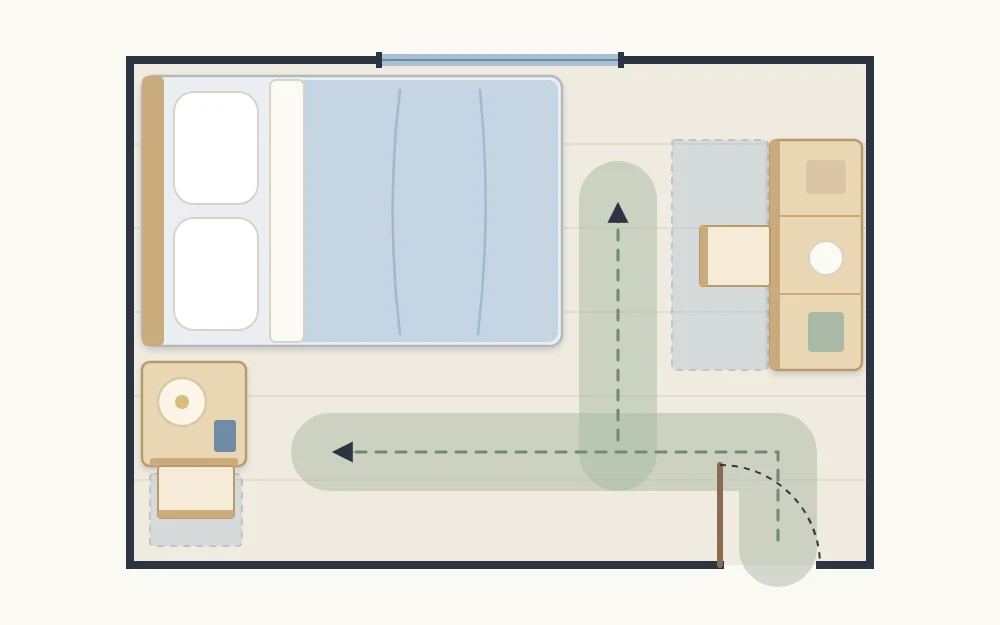
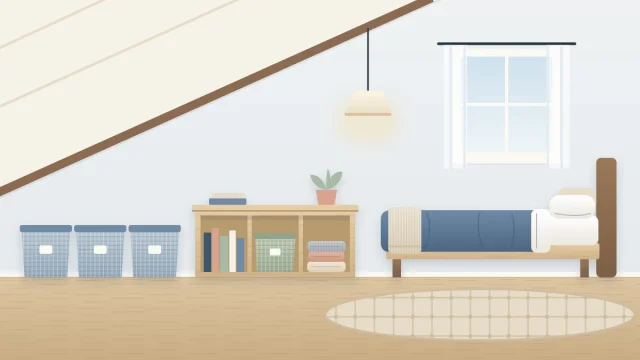
What counts as comfortable depends on you and the room. As an example, many people find a path of about 24 in (60 cm) easy to walk, but test it yourself by marking the floor before you move a heavy bed. Rooms with alcoves, slopes or dead corners have their own solutions, covered in the guide to storage for awkward bedroom corners.
Common problems and organizing answers
| Problem | Organizing answer |
|---|---|
| Things from other rooms are stored here | Move them out before adding any storage |
| Bags and shoes on the floor | Hooks behind the door; a tray or box under the bed |
| No room for a second piece of furniture | Replace one piece with a version that has drawers |
| Drawers cannot open fully | Re-measure and reposition the bed or the dresser |
| Shelves look crowded | Switch to closed bins or furniture with doors |
| No floor left at all | Use wall height, within the product’s stated limits |
| Clothes worn once pile up on the bed | Two or three hooks as their fixed home |
If two people share the room, every one of these pressures doubles, and dividing the storage clearly matters as much as adding to it. The guide to organizing a shared bedroom covers how to split the space fairly.
Frequently asked questions
Where do I start when organizing a small bedroom?
Start by removing what does not belong in a bedroom, such as paperwork, hobby supplies and overflow from other rooms. That frees more space than any container. Then clear the floor, plan the under-bed space, and only after that measure for shelves, hooks or furniture.
Should the bed go in a corner in a small bedroom?
It can free a useful stretch of floor, so it is worth trying on paper first. The trade-offs are that a corner bed is harder to make and one sleeper has no easy way out. Measure the room and the bed, and check that drawers and doors can still open.
Is open or closed storage better in a small bedroom?
Closed storage usually suits a small room better, because everything is always in view and drawers, lidded boxes and doors hide the many small items. Keep open shelves for a few things that stay neat easily, and use matching bins where a shelf has to hold loose items.