How to Organize a Nightstand Drawer
A short project that turns a bedside junk drawer into a few clear compartments: empty it, sort the contents, measure the inside, divide it with small trays and set a limit so it does not refill.
At a glance
What you need
- Damp cloth
- Tape measure
- Small trays or shallow boxes
- Drawer liner or non-slip mat
- Reusable cable ties
- Bag for trash
A bedside drawer fills up quietly. A receipt goes in, then a spare cable, a pen that may or may not work, a handful of coins, and within a few months the one thing you reach for at night is somewhere under all of it.
The good news is that this is one of the shortest projects in the room. You can organize a nightstand drawer in well under an hour, and because the drawer is small, the result is easy to keep. The steps below go in order: empty, sort, measure, divide, and set a limit.
What you need
- A damp cloth and a dry one
- A tape measure
- A bag for trash and a box for things that belong in other rooms
- Small trays, shallow boxes or simple dividers (improvised ones are fine)
- A piece of drawer liner or non-slip mat, if you have one
Step by step: emptying, sorting and measuring
- Empty the drawer completely. Tip everything onto the bed cover. Working around half the contents does not work, because you never see the whole space or the whole pile.
- Wipe it out. Go over the inside with a damp cloth, corners included, and let it dry while you sort.
- Sort into three groups. Make one group for things you use from bed, one for things that belong elsewhere in the home, and one for trash. Be strict with the first group: it is only for what you reach for while you are in bed or just getting up.
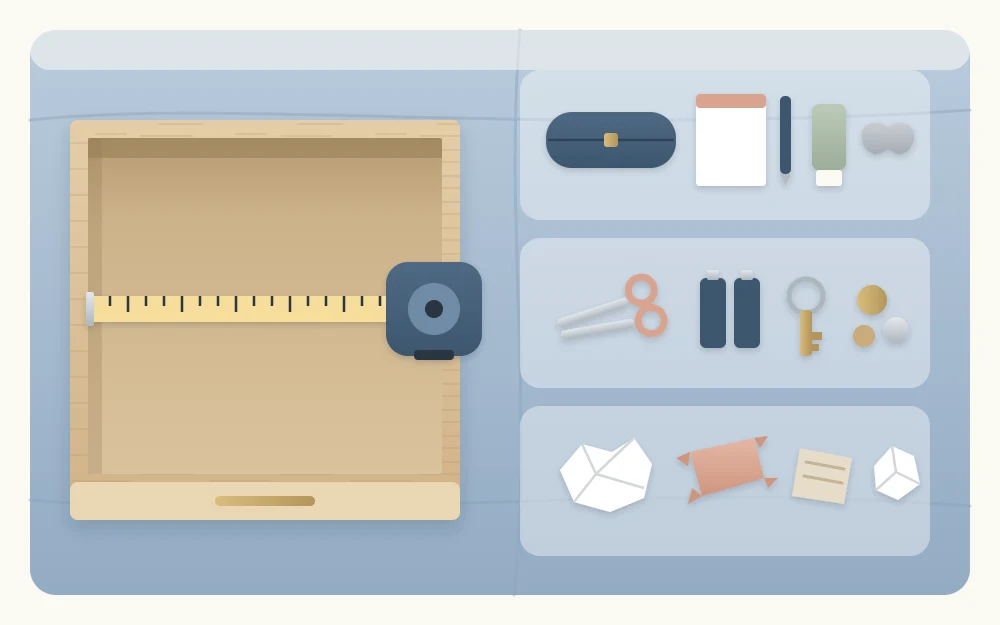
- Measure the inside of the drawer. Note the width, the depth from front to back, and the height from the base to the top edge. Measure the inside, not the drawer front, since the sides and any runners take up room.
Take the second and third groups out of the bedroom before you continue. If the box of things for other rooms stays on the floor, it tends to drift back into the drawer.
What earns a place in the drawer
The drawer works together with the nightstand top. The top holds the three or four things you use every night, and the drawer holds the small things you want within reach but out of sight. If you have not yet decided what belongs beside the bed at all, start with the guide to what to keep on and in a nightstand.
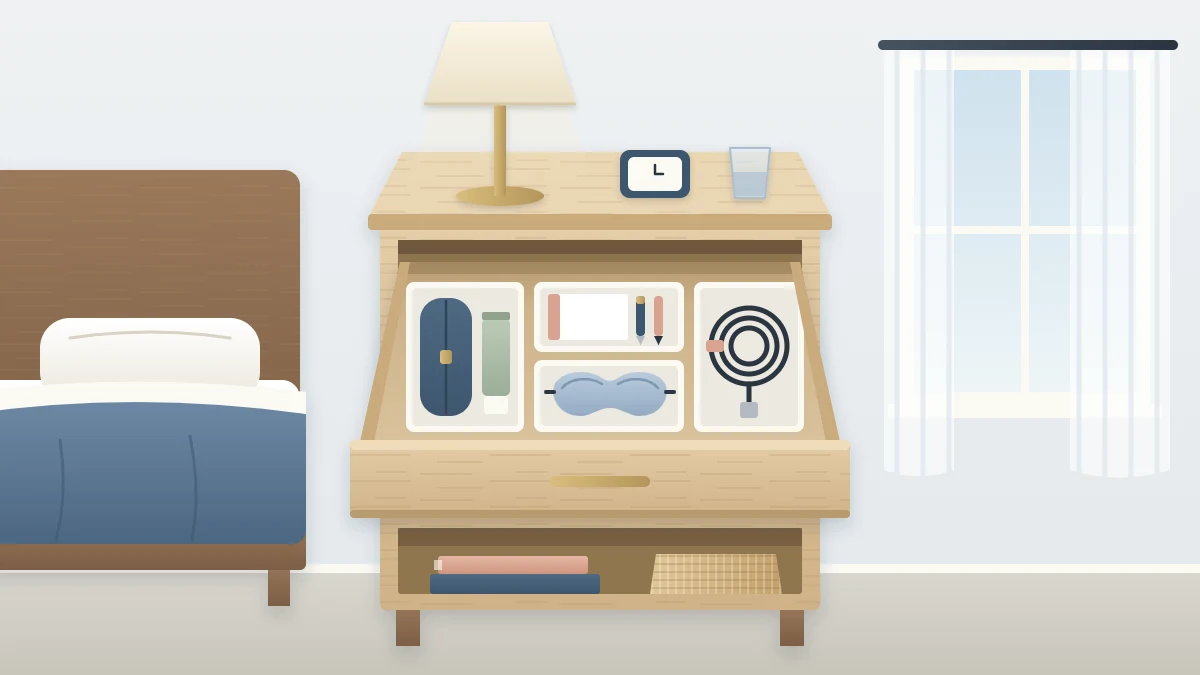
For many people the drawer list looks something like this:
- A glasses case
- Hand cream or lip balm
- A pen and a small notepad
- Earplugs and a sleep mask
- A spare charger
- A small pack of tissues
Yours may be shorter or different. What matters is that every item has a reason to be at the bedside. Coins, receipts, mail, batteries, tools and spare keys all have better homes somewhere else.
Good to know
If you keep medicines in the nightstand, follow the storage directions on the label and keep them out of the reach of children. A bedside drawer is low and easy for a child to open, so it may not be the right place in your home.
Divide the drawer into compartments
An undivided drawer mixes itself every time it opens and closes. Compartments stop that, because each group of things has walls around it.
- Put down a liner first. A piece of drawer liner or thin non-slip mat, cut to the inside measurements, keeps trays from sliding to the back each time the drawer is pushed shut. It also stops small items from rattling.
- Group what you are keeping. Lay the items out in the groups you would look for together: reading things, skin care, sleep things, cords.
- Fit a container to each group. Small trays, shallow boxes without lids and simple dividers all work. Check each one against your height measurement so the drawer still closes. A nightstand drawer is often shallow, sometimes only 2 to 3 in (5 to 8 cm) inside, so measure yours instead of guessing.
- Fill the whole base. Arrange the containers so they sit edge to edge with no large gaps. Gaps let trays shift and invite loose items.
- Put the most used group at the front. Whatever you reach for most nights goes in the front compartment on the side nearest the bed, where you can find it by touch.

You do not have to buy anything. Lids from gift boxes, small washed containers, and cut-down cardboard boxes make good trays. For a fitted grid sized to your own drawer, see the project for making drawer dividers from cardboard.
Give cords their own section
A loose cable is the fastest way to tangle a drawer. Coil each spare cord in loose loops, hold the coil with a reusable cable tie or a hook-and-loop tie, and lay it in a compartment of its own. Keep the loops relaxed and avoid sharp bends near the plug ends.
Keep only the spare you would use at the bedside. Chargers for devices you no longer own, and cables you cannot identify, can leave the room. The cords that are plugged in and in use are a separate job, covered in the guide to tidying chargers and lamp cords around the bed.
Set a limit so it stays this way
The drawer turned into a junk drawer because it had no limit, so give it one. The rule is simple: when a compartment is full, something leaves before anything new goes in. If a new item has no compartment, that is a sign it belongs somewhere else.
Tip
Leave one small compartment empty on purpose. It gives tonight’s odd item somewhere to land without undoing the rest, and you can clear it at the next check.
A quick monthly check
Once a month, or whenever suits your routine, open the drawer and look for anything that has crept in. It takes a couple of minutes:
- Remove whatever does not belong and take it to its real home.
- Throw out empty tubes, dead pens and used tissues.
- Straighten the trays and check that the liner is still flat.
- Ask whether any compartment is always overflowing or always empty, and resize it if so.
A drawer this small does not need a big system. A few compartments, a clear idea of what belongs at the bedside, and a short regular check are enough to keep it easy to use.
Frequently asked questions
What should I keep in a nightstand drawer?
Only small things you reach for from bed and want out of sight. For many people that means a glasses case, hand cream, a pen and notepad, earplugs, a sleep mask, a spare charger and tissues. Anything you would not use while in bed or just getting up belongs in another room.
How do I keep trays from sliding around in the drawer?
Lay a piece of drawer liner or thin non-slip mat on the base before the trays go in, and arrange the trays so they sit edge to edge across the whole drawer. With no large gaps and a surface that grips, they stay put when the drawer is opened and shut.
Do I need to buy a drawer organizer?
No. Box lids, small clean containers and cut-down cardboard boxes divide a drawer well, as long as they are lower than the inside height of the drawer. Using what you have for a week or two also shows which compartment sizes you really need before you spend anything.