Bedside Cable Organization: Tidy Chargers, Lamps and Cords
How to cut down the cords beside your bed, route them along the back of the nightstand, keep the phone cable within reach and give the power strip a fixed place.
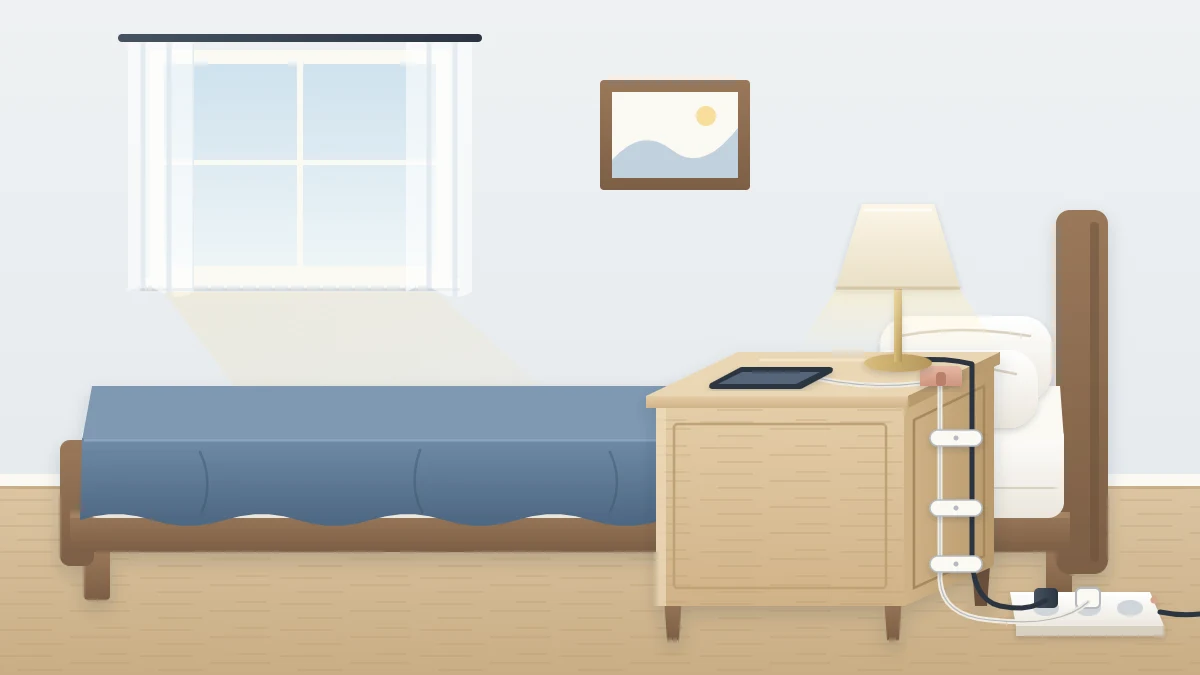
A lamp, a phone charger and perhaps a clock: three cords are enough to make a knot behind a nightstand. Bedside cable organization is mostly a matter of deciding what really needs power beside the bed, then giving each cord one route and one fixed end.
A handful of cord clips, a few reusable ties and about half an hour will deal with most bedsides.
Start by listing what needs power
Unplug everything at the bedside and lay it on the bed. Then write the short list of what truly has to be powered there. For many people it is a lamp, a phone and possibly a clock.
Everything else is a candidate to leave. A tablet, a laptop or a second charger kept “just in case” can usually charge elsewhere in the home. Each device you move takes a cord, a plug and a slot on the power strip with it. Spare chargers that stay belong coiled in a drawer compartment, as described in the guide on how to organize a nightstand drawer.
While the cords are out, look each one over. A cord with cracked covering, a bent plug or a loose connector should be replaced, not tidied.
Plan the route before you clip anything
Every cord has two ends: the outlet or power strip, and the place where the device sits. Look at where those are and choose the shortest path between them that stays out of the way. In most rooms that path runs down the back of the nightstand.
- Note which side of the nightstand the outlet is on, and send the cords down that side.
- Check that the route does not cross the gap where your feet land when you get out of bed.
- Keep the route clear of radiators and baseboard heaters.
- Make sure every plug stays easy to reach, so you can unplug something without moving furniture.
If the top of the nightstand is crowded as well, sort that out first. The guide to nightstand organization covers what earns a place there, and fewer objects usually means fewer cords.
Route the cords down the back
- Pull the nightstand forward far enough to reach behind it, and wipe the back edge and the leg with a damp cloth. Let them dry so the clips hold.
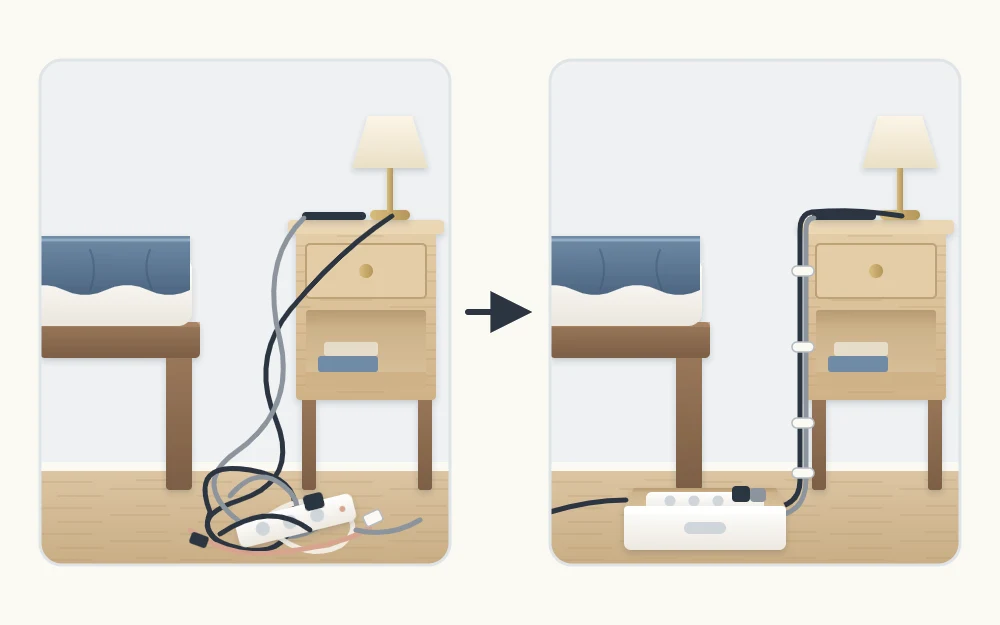
- Place the lamp cord first. It moves the least. Run it from the lamp to the back edge of the top, then straight down the rear leg or the back panel.
- Fix it with adhesive cord clips or reusable ties. A clip at the top, one near the floor and one in between is a reasonable start; adjust to the height of your furniture.
- Add the next cord beside it in the same line. Cords that travel together read as one line and can be dusted in one pass.
- Leave a little slack at each end so that nothing pulls on a plug or a connector when the lamp or the nightstand is nudged.
- Push the nightstand back and check that no cord is pinched between the furniture and the wall.
Adhesive clips vary. Follow the instructions on the pack for surface, pressing and removal, and try one where it will not show if the furniture has a delicate finish.
Keep the phone cable where you can reach it
The charging cable is the cord that moves every day, and it tends to slide off the top and disappear behind the nightstand. A small cable holder at the back edge stops that. There are two common kinds:
- A weighted holder sits on the surface and grips the cable in a slot. Nothing sticks to the furniture, and you can move it.
- A clip-style holder fastens to the edge of the top and holds the connector just above it. It takes up no surface space.
No nightstand? The alternatives in the guide to bedside storage ideas, such as a narrow shelf or a slim cart, work the same way: one line down to the outlet and a holder at the edge.
Deal with extra length
Most cords are longer than the route they travel. Gather the extra into a loose coil about the size of your hand and close it with a reusable tie, such as a hook-and-loop strap. The tie should hold the coil’s shape without squeezing it.
- Coil gently. Avoid tight folds and sharp kinks, especially near the plug and the connector.
- Rest the coil behind the nightstand or in the cable box, where it is out of sight but in open air.
Give the power strip a home
If you use a power strip, it needs a fixed place too. An open cable box or a shallow tray on the floor beside or behind the nightstand works well. It keeps the strip off the bare floor, gathers the plugs in one place and can be lifted out when you vacuum.
Choose a box or tray made for the purpose, sized so the strip and its plugs fit without being forced, and keep its openings clear. The strip should stay visible and reachable instead of buried.
Use cords and chargers as intended
Tidy routing never replaces the basics. Use chargers, cords and power strips as supplied and as their manufacturers instruct, and keep to these points:
- Do not run cords under rugs, mattresses or bedding.
- Do not cover a power strip or a charger, and do not charge a phone or other device under a pillow or on the bed.
- Keep drinks away from plugs, chargers and the power strip. A glass of water belongs on the far side of the top.
- Replace any cord that is damaged; do not tape it up.
- Do not modify a plug or a cord in any way.
Good to know
If the real problem is too few outlets near the bed, that is a question for a qualified electrician, who can advise on adding one.
Keep it tidy
Once each cord has a route, the upkeep is small. When you dust, run the cloth down the line of cords and glance at the clips. Every few months, check that the coils are still loose and that nothing new has been plugged in without a place of its own. A new device gets the same treatment as the others: one route, one tie, one fixed end.
Frequently asked questions
How do I stop my phone charger from falling behind the nightstand?
Fit a small cable holder at the back edge of the nightstand top. A weighted holder sits on the surface and grips the cable in a slot, while a clip-style holder fastens to the edge. Either one keeps the connector waiting in the same spot, so the cable no longer slides off.
What should I do with extra cord length?
Gather the extra into a loose coil about the size of your hand and close it with a reusable tie that you can reopen later. Avoid tight folds and sharp kinks, especially near the plug and the connector, and rest the coil behind the nightstand where it sits in open air.
Where should a power strip go beside the bed?
Give it a fixed place on the floor beside or behind the nightstand, ideally in an open cable box or shallow tray made for the purpose. Keep it uncovered, visible and easy to reach, and use it as its manufacturer instructs. If you need more outlets, ask a qualified electrician.