Decluttering Clothes: Deciding What Stays in Your Bedroom
A category-by-category way to sort your clothes, with four plain questions, four piles, honest answers for the hard cases and a storage-based limit on how much to keep.
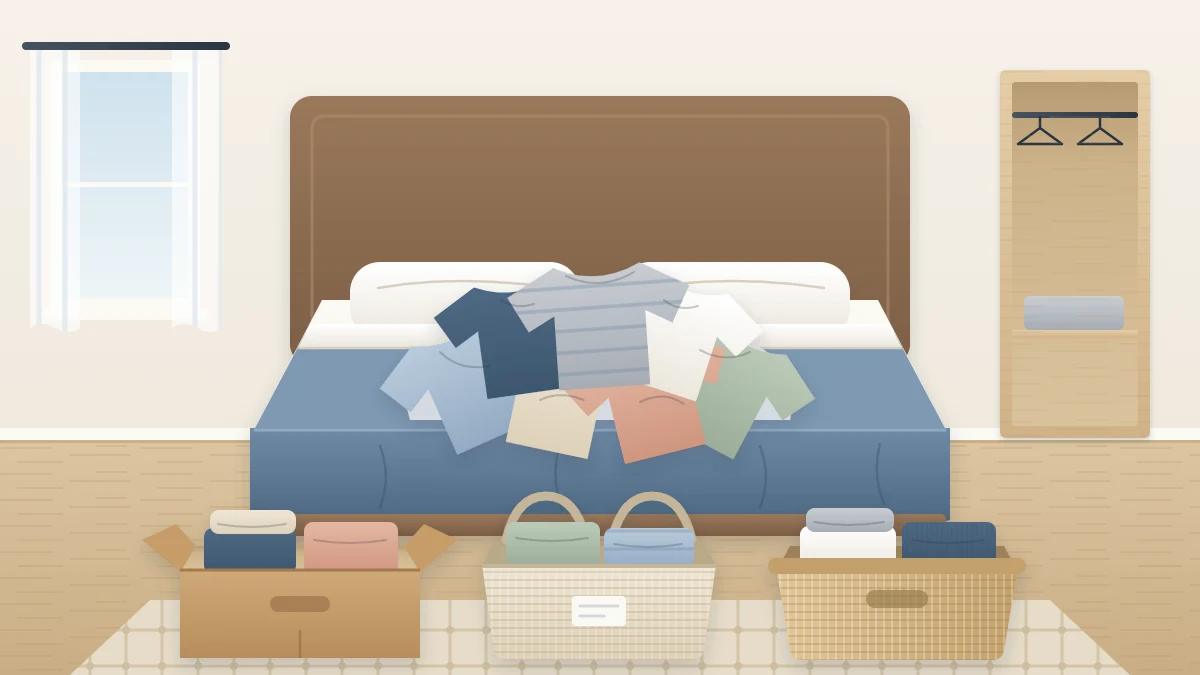
When drawers will not close and the hanging space is packed tight, the usual first thought is more storage. Often the better answer is fewer clothes. Decluttering clothes is the step that makes every other kind of bedroom organizing work, because drawers and shelves can only stay tidy when they hold less than they could.
It is also the step many people put off, since nearly every garment has a reason attached to it. The method below keeps the decisions small: one category at a time, a short list of plain questions, and a clear place for each answer.
Work on one category at a time
Sorting drawer by drawer hides the real picture, because the same kind of garment is usually spread over several places. Sorting by category shows you everything you own of one kind, side by side.
- Pick a category. Start with an easy one such as T-shirts, then trousers, then knitwear. Leave anything sentimental for last.
- Gather every item of it. Check the dresser, the hanging space, the hamper, the chair, the clean laundry and any stored boxes. Pile it all on the bed.
- Decide item by item. Pick each piece up, ask the questions below and put it in one of four piles.
- Put the keepers away before you start the next category.
One category often takes twenty minutes to an hour, so the whole job can fill an afternoon or be spread over a week of evenings. Finishing a category matters more than speed: a half-sorted bed at bedtime is how the piles end up back in the drawers. If the whole room needs attention, not just the clothes, the guide on how to declutter a bedroom sets out the wider order of work.
Four plain questions
For each item, ask:
- Does it fit now? Not after an alteration you have not booked, and not at another size.
- Is it in good condition? Look for thinning fabric, stretched necklines, stains that did not wash out and broken zippers.
- Have I worn it in the last year? A full year covers every season and most kinds of occasion.
- Would I choose it today? If you saw it in a store right now, would you pick it up?
Four clear answers of yes make a keeper. A firm no to any of them is worth a second look, and two usually settle it. Occasion wear is the fair exception to the one-year question: a formal outfit can earn its place even if you wear it rarely, as long as it fits and you would be glad to put it on.
Four places an item can go
Set up the piles before you begin, so that every decision has somewhere to land.
| Pile | What goes in it | What happens next |
|---|---|---|
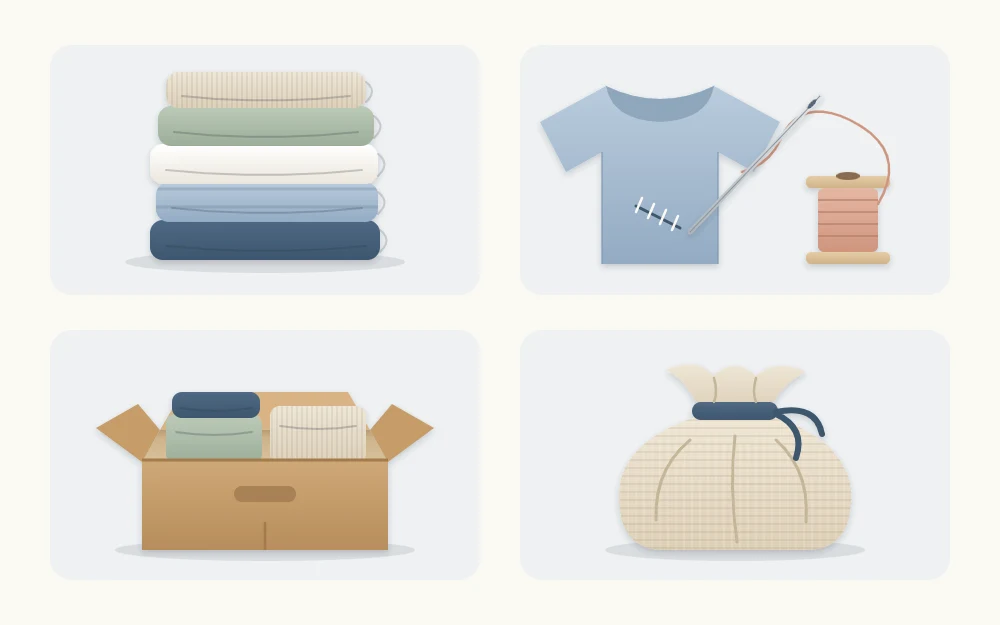
| Keep | Fits, in good condition, worn and liked | Back into its home, folded or hung |
| Mend or alter | Worth keeping once a small repair is done | Set a deadline; if it passes, the item moves on |
| Donate or sell | Clean and wearable, but not for you | Bagged and out of the room the same day |
| Textile recycling | Worn out, stained or torn beyond wearing | To a textile collection point, where one exists |
The hard cases
Some clothes are difficult for reasons that have nothing to do with wearing them. Naming the reason usually helps.
Clothes kept for a different size
Keeping a few favorites is reasonable. Keeping a second wardrobe in the best drawers is not practical. Choose the pieces you would truly be glad to wear again, pack them in one container away from your daily clothes, and let the rest go.
Gifts
A gift did its job when it was given. You are not obliged to store it, and someone else may wear it far more than you do.
Expensive mistakes
The money was spent when you bought the item, and keeping it unworn does not bring any of it back. If it is in good condition, selling it may recover a little; otherwise, donate it.
Sentimental pieces
A team shirt, a concert tee or a baby outfit is a keepsake more than clothing. Give keepsakes one small box of their own, outside the dresser, and let the size of the box set the limit.
Use a dated “maybe” box
For items you cannot decide on, do not force it. Put them in a box or bag, write the date on it and store it out of the way. Add a reminder to your calendar for a few months ahead.
When the reminder comes up, notice what you went looking for. Anything you fetched from the box has earned its place. The rest you have already lived without, which makes the decision much easier.
How many is enough?
There is no universal number of T-shirts or pairs of jeans. Households differ in how often they do laundry, what they wear to work and how much storage they have. A more useful limit is the space itself.
Decide where a category lives, such as one drawer for T-shirts, and keep what fits there comfortably, with a little room to spare. When the drawer is full, a new item means an old one leaves. Clothes folded so that each one shows from above make the limit easy to see; the guide on how to fold clothes for drawers teaches that fold.
If a category only overflows because two seasons share one drawer, the answer may be rotation instead of fewer clothes. See the guide to seasonal clothes storage for packing away what you cannot wear right now.
Where the clothes go next
Clean, wearable clothes can go to a donation center, a community clothing swap, a friend or a resale outlet. Pick the route you will follow through on this week.
Clothes that are too worn to wear should not go in with donations. Many areas have textile recycling drop-off points or collection programs, so check what is available near you. Discarded textiles add up to a large waste stream, and the U.S. Environmental Protection Agency’s page on textiles gives the background.
Take the bags out the same day
The last step is the one that makes the others count. Tie the bags, carry them out of the bedroom and put them where they will leave the home: by the front door or in the car. Bags that stay in the bedroom get reopened, and items drift back.
Frequently asked questions
Where should I start when I have too many clothes?
Start with one easy category, such as T-shirts, instead of a whole drawer or the whole room. Gather every item of that kind from the dresser, the hamper and the laundry onto the bed, decide piece by piece, and put the keepers away before moving on to the next category.
How many clothes should I keep?
No single number suits every household, because laundry routines, work and storage all differ. Let the space set the limit instead. Decide where a category lives, such as one drawer for T-shirts, and keep what fits there comfortably with a little room to spare. When it is full, something leaves before something new arrives.
What should I do with clothes that are too worn to donate?
Keep them out of the donation bag. Many areas have textile recycling drop-off points or collection programs that accept worn, stained or torn fabric, so check what is offered near you. Some pieces can also be cut up and reused at home as cleaning cloths before they are finally discarded.