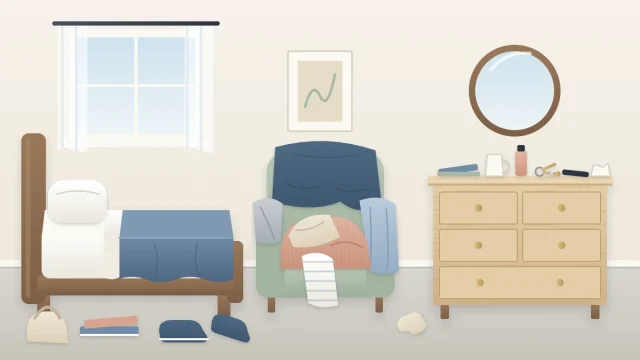
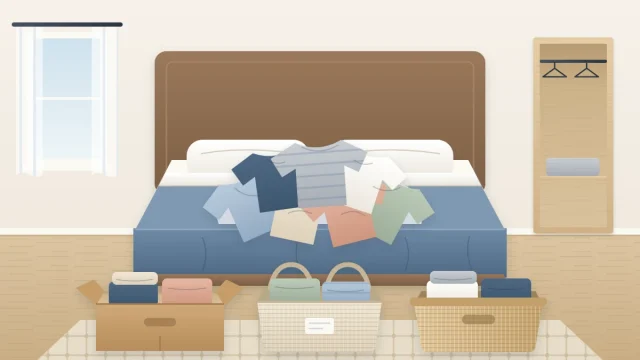
How to Declutter a Bedroom Without Getting Overwhelmed
A bedroom decluttering method built for finishing: four containers, a time limit, small areas in a fixed order, three decision questions and a dated box for the items you cannot decide on.
At a glance
What you need
- Four boxes, baskets or bags
- A timer
- A small box for keepsakes and paperwork
- One 'maybe' box with a lid
- A marker and labels
- Trash and recycling bags
The hard part of clearing a bedroom is rarely the start. It is the middle, when the bed is covered, every drawer is open and bedtime is an hour away. Most stalled attempts stall right there, and the room ends up worse than before.
So this guide on how to declutter a bedroom is built around finishing. You work in small areas with clear edges, in a fixed order, inside a time limit, and each session ends with the room usable. Nothing about it requires a free weekend or a burst of motivation.
Set up before you touch anything
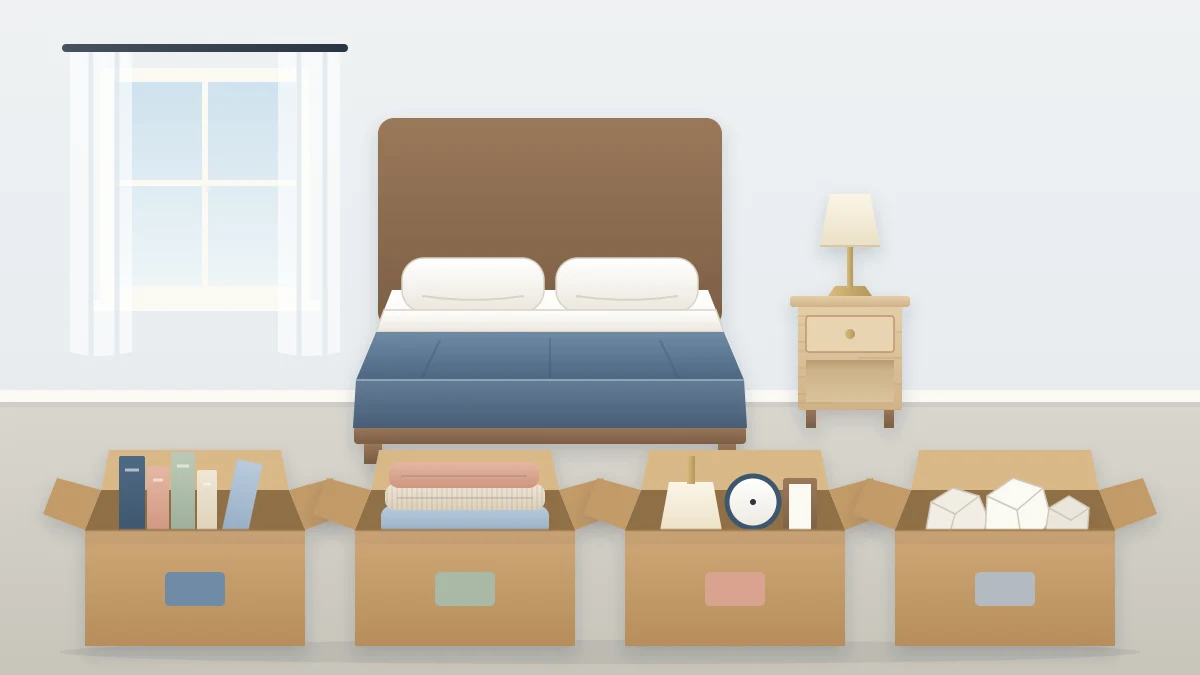
Five minutes of setup removes most of the decisions that slow you down later. You need four containers and a timer.
- Keep here. It belongs in the bedroom. This can be a pile on the bed.
- Belongs in another room. Dishes, tools, mail, other people’s things.
- Donate or sell. In good condition, but not used by you.
- Recycle or trash. Broken, worn out or empty.
Boxes, laundry baskets or bags all work. What matters is that each has one meaning and that you do not leave the room to deliver things mid-session; that is how a declutter turns into wandering around the house.
Then set a time limit. As a starting point, try 30 to 45 minutes, and stop when it ends even if you feel you could go on. A session you finished makes the next one easier to begin.
Work in small areas, in this order
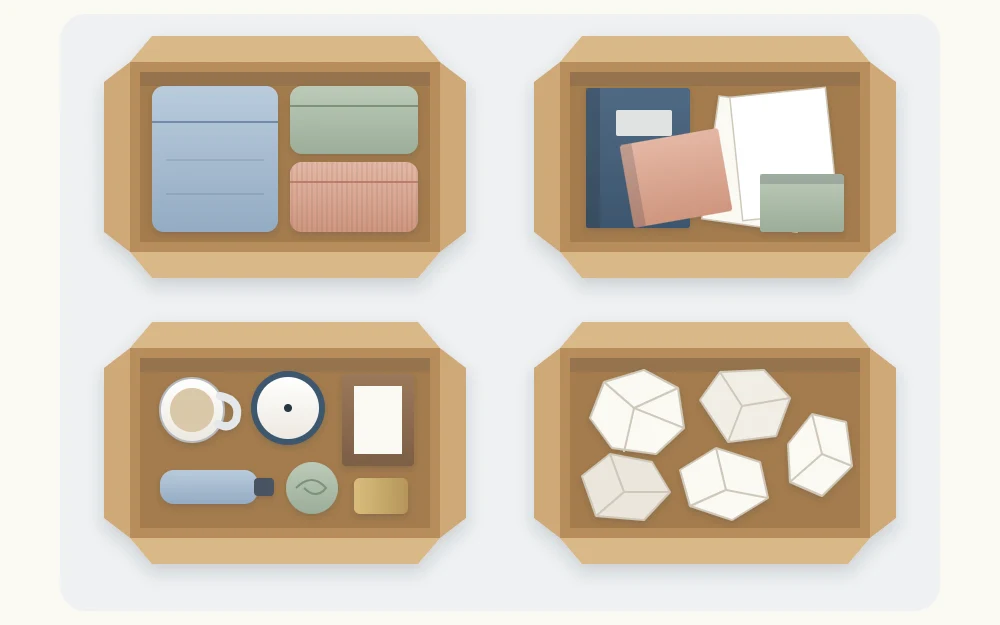
The order runs from most visible to least, so the room looks better early and stays usable throughout. Finish one area before starting the next.
- The floor. Pick up everything that is not furniture. A clear floor changes how the room looks more than any other step, and it gives you space to work.
- The bed. Clear it, make it, and from here on use it as your sorting surface.
- The surfaces. Nightstand, dresser top, chair, windowsill. Take one at a time and clear it completely before putting back the few things that live there.
- Drawers, one at a time. Empty a single drawer onto the bed, sort it, return what stays. Never have two open at once.
- Under the bed. Pull everything out, sort it, and put back only what is stored there on purpose.
One session might cover only the floor and the bed. That is a complete piece of work. Next time, you begin at the surfaces. Chairs, bedside tables and the floor by the door tend to refill first; the guide to bedroom clutter hotspots explains why and what to change.
Clothes are usually the largest category in a bedroom and deserve their own method. When you reach the drawers, follow the guide to decluttering clothes instead of deciding garment by garment here.
Three questions for each item
Pick an item up, ask, and put it in a container. Try not to set anything back down undecided.
- Do I use it? Not “could it be useful” but “have I used it in the past year, and will I again.”
- Would I look for it here? If you needed it tomorrow, is the bedroom where you would search? If not, it goes in the other-room container.
- Does it belong in a bedroom at all? Paperwork, hobby supplies and household spares often end up here only because the door closes.
A yes to all three means it stays. Any no means it leaves the room, although not necessarily the home.
The hard items: a “maybe” box with a date
Some things resist a quick answer: a gift you never used, a costly purchase, something that might fit again. Standing over them is where sessions stall.
Give yourself one “maybe” box. Put the difficult items in, close it and write a date on the lid, a few months ahead as a guide. Store it out of the bedroom if you can. When the date arrives, anything you did not open the box to fetch can usually go without a second debate. The limit is one box; when it is full, something must come out before another goes in.
Tip
If you notice you are slowing down, switch to the easiest category in front of you, such as obvious trash or things that belong to someone else. Quick decisions rebuild pace.
Sentimental items and paperwork
Letters, photographs, keepsakes and documents take a different kind of attention. Reading one old card can use up the whole session.
Give them a single small box. As you find them, drop them in without reading. When the bedroom is done, take the box to a table in another room and deal with it there, on another day. The bedroom session stays about the bedroom.
End every session by taking things out
This step is what separates a finished declutter from a rearranged one. Stop five to ten minutes before your time limit and close out:
- Carry the trash and recycling to the bins outside the room.
- Deliver the other-room items to their rooms. Setting them down in the right room is enough for now.
- Put the donation bag by the front door or in the car, where you will pass it.
- Return the “keep here” items to the best home you have for them today.
A donation bag left in the corner of the bedroom is still clutter, and after a week it starts being unpacked. Getting it out of the room on the same day closes the decision.
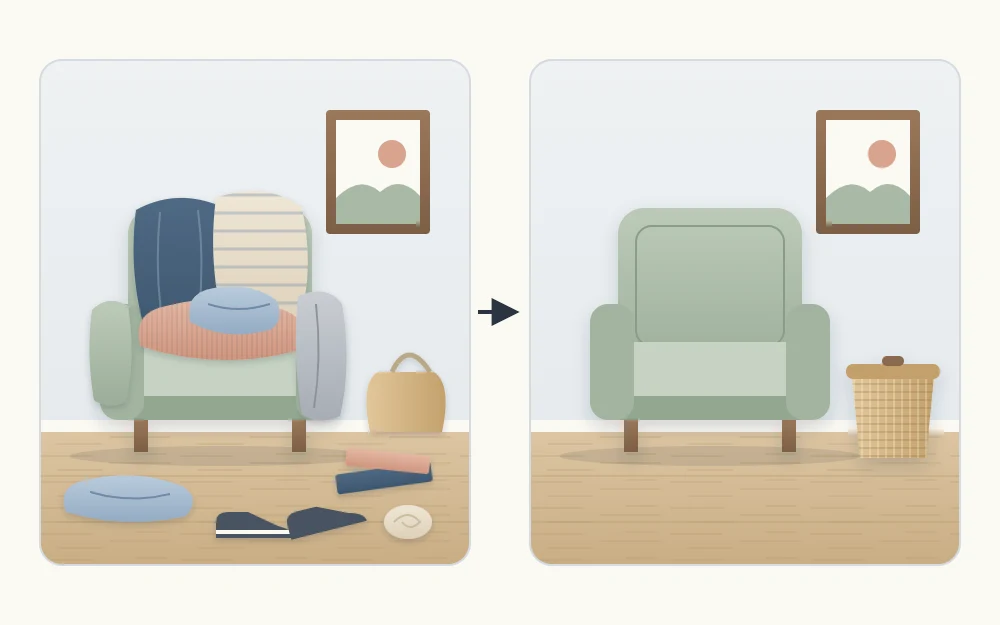
If you stall halfway
It happens to most people, and it is not a character flaw. It is usually a sign that the area was too big or the time too long. Make the next unit smaller: one drawer instead of the dresser, one shelf instead of the bookcase, ten minutes instead of forty.
If the bed is buried and you need to sleep, put the undecided items into one box, label it with tomorrow’s date and move it out of the way. You have lost nothing, and tomorrow’s starting point is a single box.
What comes next
Decluttering decides what stays. It does not yet decide where things live. Once the outgoing piles are gone, the next jobs are zones, homes and measured storage, in that order, as set out in the step-by-step plan for organizing a bedroom.
If you would rather do the declutter and the organizing in one stretch, the weekend bedroom organization project lays out a schedule across two days.
Frequently asked questions
Where should I start decluttering a bedroom?
Start with the floor, then the bed. These are the most visible areas, so the room looks better within the first session, and a cleared, made bed gives you a surface for sorting. Leave drawers and the space under the bed until the open areas are finished.
How long should a decluttering session last?
Short enough that you finish it. Many people do well with 30 to 45 minutes, including the last few minutes spent carrying the outgoing piles out of the room. If that feels like too much, ten minutes on a single drawer is a complete session and still counts.
What do I do with things I cannot decide on?
Put them in one 'maybe' box, close it and write a date on the lid a few months ahead. Keep the box outside the bedroom if possible. When the date comes, items you never went back for are usually easy to let go. Limit yourself to a single box.